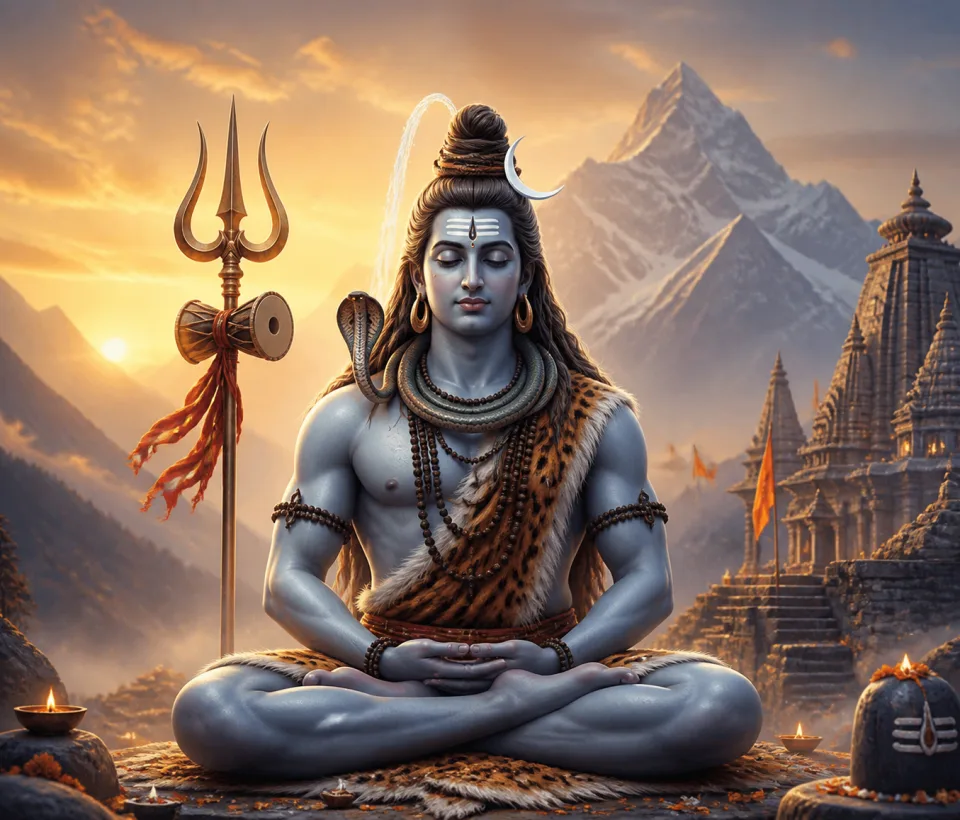
Kaal Bhairav Chalisa addresses Shiva’s time-transcending guardian form through the drum, noose, dog vehicle, cremation-ground meditation, and the defeat of destructive forces. Its language is compact and direct.
Although older descriptive fields expected forty stanzas, the stored composition closes its teaching after fourteen units, states the fruit of singing it, and supplies a complete final doha. This edition follows that internally verified text exactly.
Quick Facts
Kaal Bhairav Chalisa Lyrics in English
Read the complete source-linked devotional sequence in simple Roman script.
Opening Doha
Jay jay jay jay kal bhairavi, karahu kripa din jani
Nath sakal sansar ke, dukh harahu bhagavan
Kaal Bhairav Chalisa
Jay bhairav bhuton ke natha sankat mochan karahu vidhata
Kal rup tum karal sujana dusht dalan jag men vidhi nana
Bhut pret pishach nishachar sabhi bhay khave tumhari najar
Rudr rup dhari kal tum ae trahi trahi sab lok chillae
Damarudhari, gale men phanda bina tumhari kripa na phanda
Saty asaty ka tum ho jnyata trilok men tum palan data
Rakt pan ki bhukh tumhari dusht dalan ki riti tumhari
Shvan vahan sang tum ate shamashan men tum dhyan lagate
Dinabandhu, dayalu kripanidhi sada sahayak ho bhavasindhi
Asur nikandan, jag ke trata jay jay jay kalike bhrata
Mahakal ki kripa tumhari jo bhi sharan pade duhkh hari
Bhairav dhyan kare jo koi sankat nikat na ave koi
Jay ho baba bhairav natha navagrah dosh mitaven sata
Jo koi yah chalisa gave sab sankat se mukti pave
Closing Doha
Bhairav chalisa jo koi, path kare ur dhar
Sab kashton ka nash kar, bhav se lage par
Kaal Bhairav Chalisa Meaning in English
Opening Doha Meaning
Repeated victory is offered to Kaal Bhairav, Lord of all, who is asked to recognize the humble devotee and remove suffering.
Chalisa Meaning
Bhairav, Lord over spirits, is asked to act as the divine remover of crisis.
His formidable form embodies time and confronts harmful forces in many ways.
Ghosts, restless spirits, and night-wandering beings are pictured as fearing his gaze.
He arrives in Rudra’s form, and the worlds cry out for protection before that power.
He bears the drum and a noose, while the devotee admits that release depends upon his grace.
Kaal Bhairav knows truth from falsehood and is praised as a sustaining Lord of the three worlds.
The source uses fierce blood imagery to express his relentless destruction of evil.
He comes with the dog as his vehicle and is imagined absorbed in meditation at the cremation ground.
Compassionate friend of the lowly, he is asked to remain a helper across the ocean of existence.
The destroyer of demons and protector of the world is acclaimed as Kali’s brother.
Whoever takes refuge is said to receive the grace associated with Mahakaal and relief from sorrow.
One who meditates on Bhairav seeks a life in which crisis cannot draw near.
Baba Bhairavnath is praised and asked to quiet the difficult influence of the nine grahas.
The brief main sequence ends by linking sincere singing with release from every distress.
Closing Doha Meaning
Whoever holds this Chalisa in the heart seeks the destruction of suffering and safe passage across worldly existence.
Kaal Bhairav Chalisa: Time, Thresholds, and Refuge
Kaal Bhairav is approached as a guardian at difficult thresholds. The cremation ground, noose, and dark beings make mortality visible, while the prayer seeks steadiness rather than denial.
This particular stored hymn is a short Chalisa-form composition. Its internal conclusion matters more than an assumed stanza total, so no missing lines have been invented to make forty.
Main Themes in the Kaal Bhairav Chalisa
Truthful discernment stands beside fierce protection: the Lord is praised as one who knows truth and falsehood.
Refuge transforms frightening symbols into reminders that fear, grief, and mortality can be faced with disciplined attention.
How to Read the Kaal Bhairav Chalisa
Read the opening invocation, all fourteen main units, and the closing doha without inserting conventional verses from another Bhairav text.
The graha language belongs to devotional tradition; it should support reflection and never replace qualified medical, legal, or financial advice.
Frequently Asked Questions
No. Its final main unit and closing doha explicitly complete this short stored composition.
The dog is Kaal Bhairav’s traditional vehicle and appears here as part of his guardian iconography.
It places the prayer at the boundary of mortality, where fear is met through remembrance and discipline.
No. It explains the source’s devotional language without guaranteeing worldly or health outcomes.