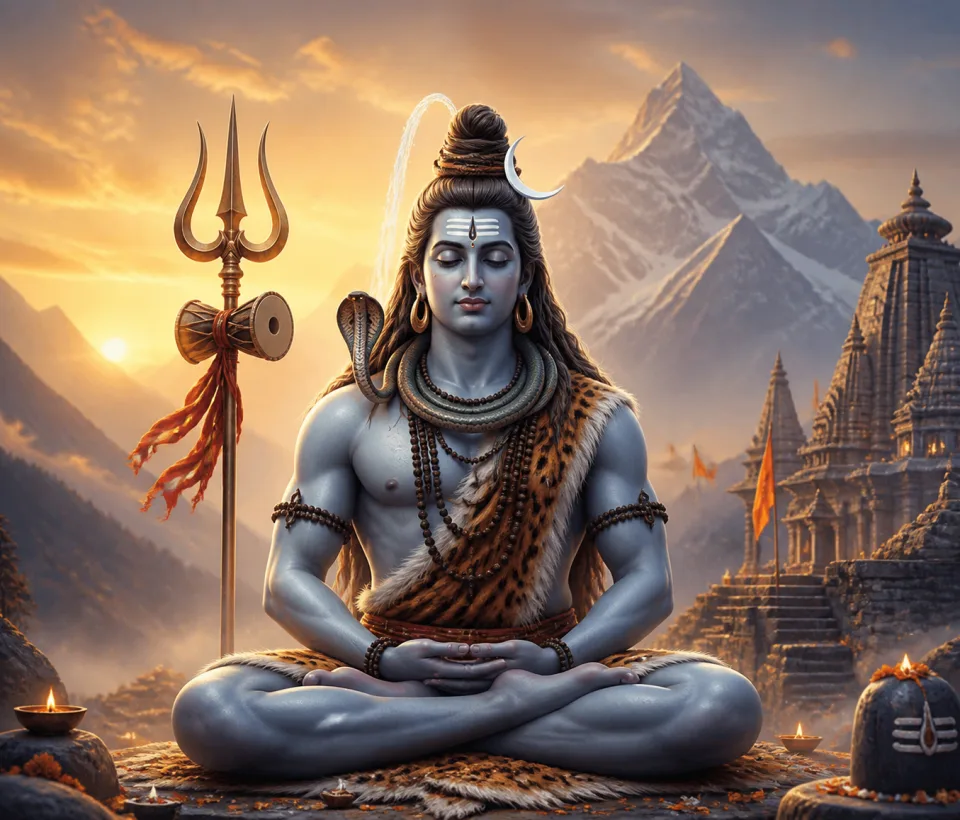
Bhairav Chalisa praises a fierce yet protective form of Shiva through the images of Kashi, Batuk Bhairav, the trident, drum, dog companion, and the company of yoginis. The prayer repeatedly turns formidable imagery toward courage and refuge.
The stored hymn ends with Sundar Das naming his composition and then a separate closing plea. Those literary endings confirm that its thirty-six main units form the complete internal source, despite older page labels that assumed forty.
Quick Facts
Bhairav Chalisa Lyrics in English
Read the complete source-linked devotional sequence in simple Roman script.
Opening Dohas
Shri ganapati guru gauri pad prem sahit dhari math
Chalisa vandan karaun Shri shiv bhairavanath
Shri bhairav sankat haran mangal karan kripal
Shyam varan vikaral vapu lochan lal vishal
Bhairav Chalisa
Jay jay Shri kali ke lala jayati jayati kashi-kutavala
Jayati batuk-bhairav bhay hari jayati kal-bhairav balakari
Jayati nath-bhairav vikhyata jayati sarv-bhairav sukhadata
Bhairav rup kiyo shiv dharan bhav ke bhar utaran karan
Bhairav rav suni hvai bhay duri sab vidhi hoy kamana puri
Shesh mahesh adi gun gayo kashi-kotaval kahalayo
Jata jut shir chandr virajat bala mukut bijayath sajat
Kati karadhani ghungharu bajat darshan karat sakal bhay bhajat
Jivan dan das ko dinhyo kinhyo kripa nath tab chinhyo
Vasi rasana bani sarad-kali dinhyo var rakhyo mam lali
Dhany dhany bhairav bhay bhanjan jay manaranjan khal dal bhanjan
Kar trishul damaru shuchi koda kripa kataksh suyash nahin thoda
Jo bhairav nirbhay gun gavat ashtasiddhi nav nidhi phal pavat
Rup vishal kathin dukh mochan krodh karal lal duhun lochan
Aganit bhut pret sang dolat ban ban ban shiv ban ban bolat
Rudrakay kali ke lala maha kalahu ke ho kala
Batuk nath ho kal ganbhira shvet rakt aru shyam sharira
Karat ninahun rup prakasha bharat subhaktan kahan shubh asha
Ratn jadit kanchan sinhasan vyaghr charm shuchi narm suanan
Tumahi jai kashihin jan dhyavahin vishvanath kahan darshan pavahin
Jay prabhu sanharak sunand jay jay unnat har uma nand jay
Bhim trilochan svan sath jay vaijanath Shri jagatanath jay
Maha bhim bhishan sharir jay rudr tryambak dhir vir jay
Ashvanath jay pretanath jay svanarudh sayachandr nath jay
Nimish diganbar chakranath jay gahat anathan nath hath jay
Treshalesh bhutesh chandr jay krodh vats amaresh nand jay
Shri vaman nakulesh chand jay krityau kirati prachand jay
Rudr batuk krodhesh kaladhar chakr tund dash panivyal dhar
Kari mad pan shambhu gunagavat chaunsath yogin sang nachavat
Karat kripa jan par bahu dhanga kashi kotaval adabanga
Deyan kal bhairav jab sota nasai pap mota se mota
Janakar nirmal hoy sharira mitai sakal sankat bhav pira
Shri bhairav bhutonke raja badha harat karat shubh kaja
Ailadi ke duhkh nivarayo sada kripakari kaj samharayo
Sundar das sahit anuraga Shri durvasa nikat prayaga
Shri bhairav ji ki jay lekhyo sakal kamana puran dekhyo
Closing Doha
Jay jay jay bhairav batuk svami sankat tar
Kripa das par kijie shankar ke avatar
Bhairav Chalisa Meaning in English
Opening Dohas Meaning
Bowing lovingly to Ganapati, the Guru, and Gauri, the poet begins this praise of Shiva as Bhairavanath.
Bhairav is invoked as compassionate remover of distress, dark and formidable in form, with great red eyes.
Chalisa Meaning
Victory is offered to the son of Kali and celebrated guardian of Kashi.
Batuk Bhairav removes fear, while Kaal Bhairav is praised for decisive strength.
The renowned Nath Bhairav is acclaimed as a giver of well-being in every Bhairav form.
Shiva assumes the form of Bhairav to lighten the burden of worldly existence.
Hearing Bhairav’s powerful call drives fear away and supports the fulfilment of worthy aims.
Shesha, Mahesha, and others sing his virtues, and he is known as Kashi’s kotwal or guardian.
Matted locks and the moon adorn his head, together with a splendid crown.
Bells sound at his waist, and the sight of him makes every fear flee.
The Lord granted life to his servant, whose recognition of him arose through that grace.
Sharada and Kali are said to dwell upon the tongue, granting the blessing requested by the devotee.
Blessed is Bhairav, destroyer of fear, who delights the mind and breaks hostile forces.
He carries trident, drum, and pure whip; his gracious glance and good renown are abundant.
Whoever sings Bhairav’s virtues without fear seeks the eight attainments and nine treasures.
His immense form relieves deep suffering, while anger flashes through both red eyes.
Countless spirits move with him as the sound of Shiva is repeated.
He has Rudra’s body, is called Kali’s son, and stands beyond even great Time.
Batuk Nath is profound as time and appears in white, red, and dark forms.
These three forms shine forth and fill sincere devotees with auspicious hope.
He sits on a gem-set golden throne, with tiger skin and a faithful dog beside him.
People meditate on him in Kashi before receiving the vision of Vishvanath.
Acclaim is offered to the Lord as destroyer, elevated protector, and joy of Uma.
The hymn salutes fierce three-eyed Bhairav with his dog, together with Vaijanath and Jagatnath.
His body is tremendously awe-inspiring, yet Rudra Tryambak is steadfast and heroic.
Praise goes to Ashvanath and Pretanath, and to the Lord who rides with his dog.
The sky-clad Chakranath takes the hand of those who have no protector.
Several lordly names are acclaimed, presenting Bhairav as master of beings and divine power.
Vaman, Nakulesh, and fierce forms are praised for their formidable renown.
Rudra Batuk and Krodhesh bear emblems of time, the discus, fierce jaws, and serpent power.
Singing Shambhu’s virtues, he dances among the sixty-four yoginis.
The unconventional guardian of Kashi shows compassion to people in many different ways.
When Kaal Bhairav raises his staff, even the heaviest wrongdoing is said to dissolve.
The devotee’s being becomes purified, and worldly pain and every crisis are eased.
Bhairav, king over spirits, removes obstructions and enables auspicious work.
He relieved Ailadi’s suffering and continually guided that devotee’s affairs with grace.
Sundar Das composes with devotion near Durvasa’s sacred place at Prayag.
The poet records Bhairav’s victory and testifies to seeing sincere wishes brought to completion.
Closing Doha Meaning
Batuk Bhairav, manifestation of Shankara, is repeatedly praised and asked to remove distress and show grace to his servant.
Bhairav Chalisa: Fierce Form, Protective Purpose
Bhairav’s fearsome symbols are not presented as uncontrolled violence. Within the hymn they mark vigilance, justice, and the power to protect people who feel exposed to danger.
Kashi supplies the text’s sacred geography. Bhairav is remembered as its kotwal, while Vishvanath, Durvasa near Prayag, the yoginis, and several named forms widen the devotional landscape.
Main Themes in the Bhairav Chalisa
Fear is answered through steadfast guardianship: the frightening form becomes a source of courage for the vulnerable.
The composition moves from divine names and emblems to the poet’s own witness, ending in trust rather than spectacle.
How to Read the Bhairav Chalisa
Keep the two opening dohas together, then read the thirty-six main units as the complete source before its final prayer.
Let the fierce language encourage ethical courage and alertness; it should never be used to direct fear or hostility toward another person.
Frequently Asked Questions
The internal text reaches an authorial signature and a separate closing doha after stanza 36, establishing a complete unusual form.
The hymn uses this traditional title to present him as the sacred city’s vigilant guardian.
The source names Batuk Bhairav, Kaal Bhairav, Nath Bhairav, and numerous other protective forms.
Its devotional purpose is protection, fearlessness, moral vigilance, and refuge—not harm toward others.