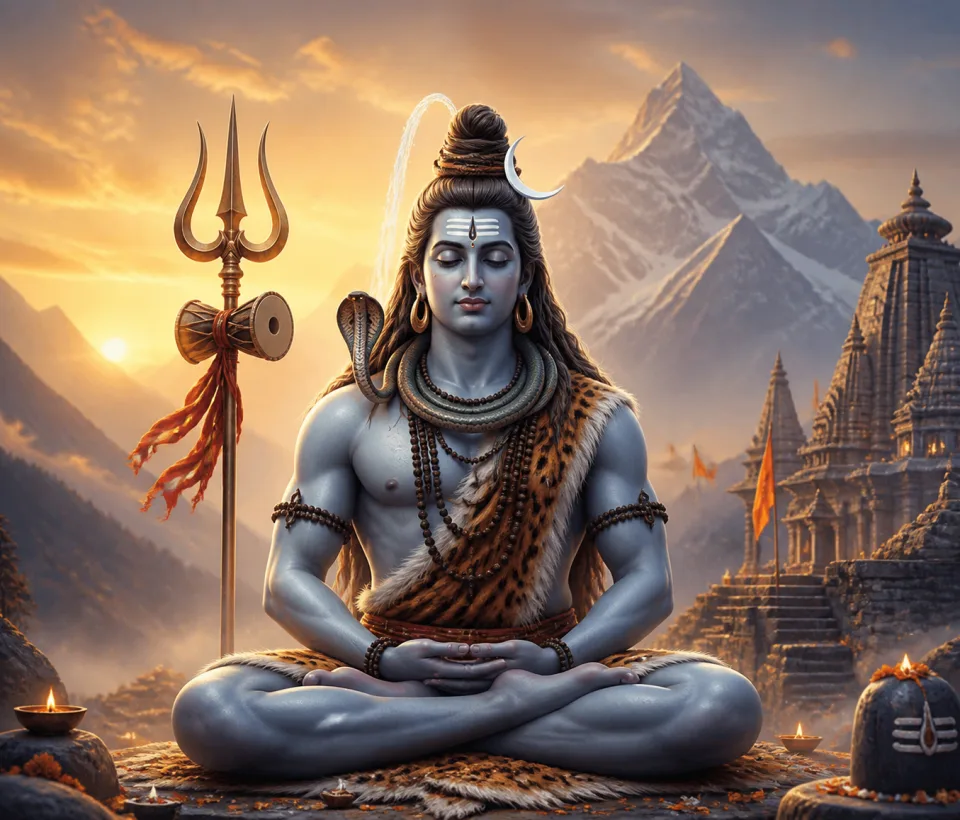
The Shiv Chalisa is a devotional hymn that approaches Lord Shiva as the compassionate guardian of those who seek refuge in him. Its imagery moves from the moon, Ganga, serpents, sacred ash, and trident to stories of protection and heartfelt prayer.
This edition keeps the complete Hindi source sequence in accessible Roman script and follows it with a natural English explanation for prayer, study, and cultural understanding.
Quick Facts
Shiv Chalisa Lyrics in English
Read the complete source-linked devotional sequence in simple Roman script.
Opening Doha
Jay ganesh girija suvan, mangal mul sujan
Kahat ayodhyadas tum, dehu abhay varadan
Shiv Chalisa
Jay girija pati din dayala sada karat santan pratipala
Bhal chandrama sohat nike kanan kundal nagaphani ke
Ang gaur shir gang bahaye mundamal tan kshar lagae
Vastr khal baghambar sohe chhavi ko dekhi nag man mohe
Maina matu ki have dulari bam ang sohat chhavi nyari
Kar trishul sohat chhavi bhari karat sada shatrun kshayakari
Nandi ganesh sohai tahan kaise sagar madhy kamal hain jaise
Kartik shyam aur ganarau ya chhavi ko kahi jat na kau
Devan jabahin jay pukara tab hi dukh prabhu ap nivara
Kiya upadrav tarak bhari devan sab mili tumahin juhari
Turat shadanan ap pathayau lavanimesh mahan mari girayau
Ap jalandhar asur sanhara suyash tumhar vidit sansara
Tripurasur san yuddh machai sabahin kripa kar lin bachai
Kiya tapahin bhagirath bhari purab pratijnya tasu purari
Danin mahan tum sam kou nahin sevak stuti karat sadahin
Ved mahi mahima tum gai akath anadi bhed nahin pai
Prakati udadhi manthan men jvala jarat surasur bhae vihala
Kinhi daya tahan kari sahai nilakanth tab nam kahai
Pujan ramachandr jab kinha jit ke lank vibhishan dinha
Sahas kamal men ho rahe dhari kinh pariksha tabahin purari
Ek kamal prabhu rakheu joi kamal nayan pujan chahan soi
Kathin bhakti dekhi prabhu shankar bhae prasann die ichchhit var
Jay jay jay anant avinashi karat kripa sab ke ghatavasi
Dusht sakal nit mohi satavai bhramat rahaun mohi chain na avai
Trahi trahi main nath pukaro yehi avasar mohi an ubaro
Lai trishul shatrun ko maro sankat te mohi an ubaro
Mat pita bhrata sab hoi sankat men puchhat nahin koi
Svami ek hai as tumhari ay harahu mam sankat bhari
Dhan nirdhan ko det sada hin jo koi janche so phal pahin
Astuti kehi vidhi karain tumhari kshamahu nath ab chuk hamari
Shankar ho sankat ke nashan mangal karan vighn vinashan
Yogi yati muni dhyan lagavain sharad narad shish navavain
Namo namo jay namah shivay sur brahmadik par na pay
Jo yah path kare man lai ta par hot hai shambhu sahai
Riniyan jo koi ho adhikari path kare so pavan hari
Putr hon kar ichchha joi nishchay shiv prasad tehi hoi
Pandit trayodashi ko lave dhyan purvak hOm karave
Trayodashi vrat karai hamesha take tan nahin rahai kalesha
Dhup dip naivedy chadhave shankar sammukh path sunave
Janm janm ke pap nasave ant dham shivapur men pave
Closing Doha
Nit nem uthi pratahhi, path karo chalis
Tum meri manakamana, purn karo jagadish
Shiv Chalisa Meaning in English
Opening Doha Meaning
Victory to Ganesha, the wise son of Girija and source of auspiciousness; Ayodhyadas asks him to grant freedom from fear.
Chalisa Meaning
Glory to Shiva, compassionate lord of Girija who always protects the saints; the crescent moon shines on his forehead and serpents adorn his ears.
His fair body bears the flowing Ganga, a garland of skulls, and sacred ash; his tiger-skin garment and wondrous appearance captivate every being.
Parvati, beloved daughter of Maina, shines beautifully at his left side; the trident in his hand destroys hostile forces.
Nandi and Ganesha look radiant beside him like lotuses in an ocean, while Kartikeya and Shiva’s attendants complete a scene beyond description.
Whenever the gods cried out, Shiva removed their sorrow; when Taraka caused great havoc, they all sought his help.
He immediately sent six-faced Kartikeya, who struck Taraka down in an instant; Shiva also destroyed Jalandhara, a deed renowned throughout the world.
In the battle with Tripurasura he protected all by his grace, and he fulfilled the solemn purpose of Bhagiratha’s great penance.
No giver is equal to Shiva, whose servants continually praise him; the Vedas proclaim his beginningless greatness but cannot discover its limit.
When poison blazed forth from the churning ocean and terrified gods and demons alike, he compassionately helped them and became known as Nilakantha.
Rama worshipped Shiva before winning Lanka and giving it to Vibhishana; Shiva then tested the devotion expressed through a thousand lotuses.
When one lotus was hidden, lotus-eyed Rama offered his own eye; seeing such steadfast devotion, Shiva gladly granted the desired boon.
Victory to the infinite, imperishable indweller who blesses every heart; the devotee now confesses being tormented by harmful forces and unable to find peace.
The distressed devotee cries for rescue at this very moment and asks Shiva to wield his trident, defeat adversity, and lead him out of danger.
In deep trouble even relatives may fail to help; Shiva alone is accepted as master, and the devotee asks him to remove this heavy distress.
Shiva gives generously even to the poor, and sincere seekers receive the fruit they ask for; the speaker admits being unable to praise him properly and seeks forgiveness.
Shankara destroys distress, creates auspiciousness, and removes obstacles; yogis, ascetics, sages, Sharada, and Narada all bow in meditation before him.
Repeated salutations are offered through “Namah Shivaya”; even Brahma and the gods cannot reach his limit, yet Shiva supports whoever reads this hymn attentively.
A burdened person who reads it with sincerity is freed from that weight, and one who longs for a child is assured of Shiva’s grace.
The hymn recommends worship with focused ritual on Trayodashi; one who faithfully observes its discipline is said to be freed from bodily affliction.
Incense, lamp, and food offerings are placed before Shiva as the hymn is recited; its prayer is for old faults to be erased and for the final journey to lead to Shiva’s abode.
Closing Doha Meaning
The closing asks the Lord of the universe to accept a disciplined reading each morning and bring the devotee’s heartfelt wish to completion.
Shiv Chalisa: Background and Devotional Context
The received text names Ayodhyadas and combines visual praise, well-known Shaiva narratives, and a devotee’s direct appeal. Rather than developing one continuous story, it gathers many ways in which Shiva is remembered.
Its language makes a large theological idea intimate: the ascetic lord of Kailash is also Bholenath, the accessible master who hears a sincere call. That movement from cosmic imagery to personal trust gives the hymn its devotional shape.
Main Themes in the Shiv Chalisa
Renunciation and care appear together. Ash, serpents, and wilderness imagery suggest freedom from convention, while Nilakantha expresses the willingness to bear pain for the welfare of others.
The hymn also holds strength and tenderness together. Shiva destroys harmful forces, yet the devotee repeatedly approaches him through humility rather than fear.
A final theme is refuge: recitation becomes a way to gather an anxious mind and redirect it toward steadiness, accountability, and trust.
How to Read the Shiv Chalisa
Read at a measured pace and pause between the short Roman stanzas. The spelling is designed for accessibility, so readers may naturally follow the pronunciation used in their family or community.
No elaborate setup is necessary for a personal reading. A quiet place, respectful attention, and time to read the meaning afterward are enough to begin.
Frequently Asked Questions
It is a devotional hymn praising Lord Shiva through descriptions of his form, sacred narratives, requests for protection, and a concluding prayer.
The name recalls the tradition that Shiva held the dangerous poison from the cosmic ocean in his throat to protect creation.
Yes. Roman script helps readers follow the Hindi sound of the source even when they do not read Devanagari.
Many devotees associate it with Monday, Pradosh, and Maha Shivaratri, though a personal reading can be made on any day.
No. The Chalisa is a longer devotional hymn, while the Mahamrityunjaya Mantra is a compact Vedic mantra used in repeated recitation.