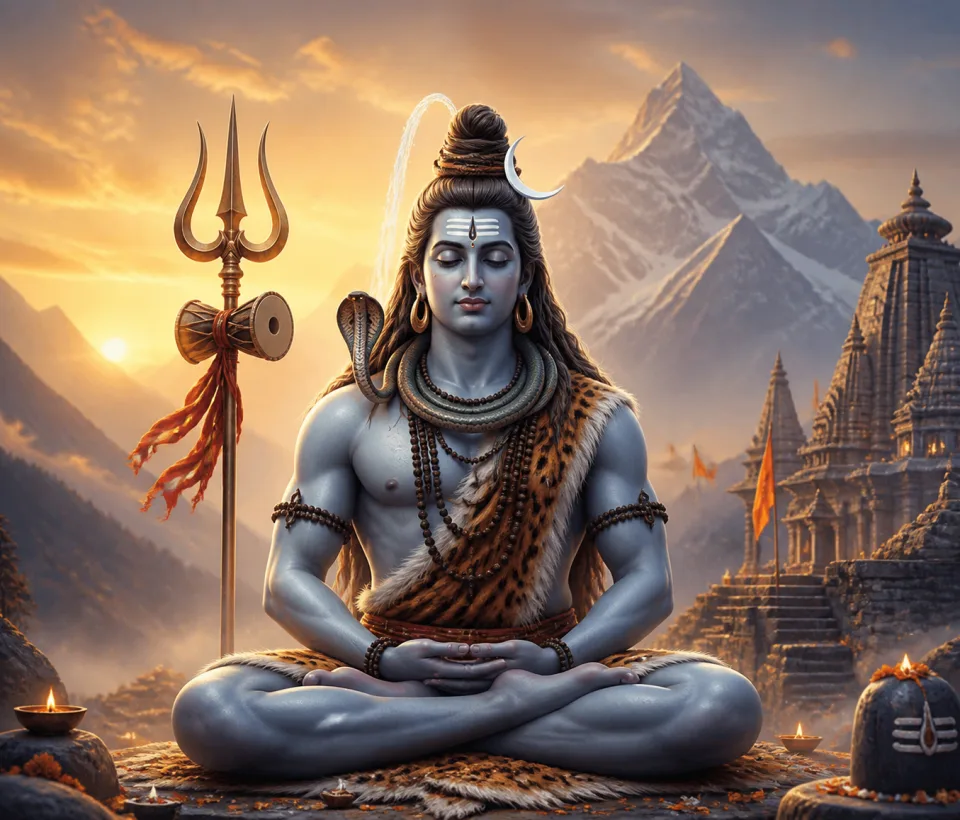
Om Jai Shiv Omkara is a Hindi Aarti that praises Shiva through images of the divine forms, their emblems, consorts, vehicles, and sacred places. Every stanza in the stored source closes with the same invocation to Shiva as Omkara.
The Roman lyrics below preserve the twelve-stanza sequence and keep the refrain inside each stanza. A corresponding English meaning follows every lyric unit.
Quick Facts
Om Jai Shiv Omkara Aarti Lyrics in English
Read the complete source-aligned Aarti in simple Roman script. The recurring refrain is emphasized within the same continuous sequence.
Aarti and Refrain
Om jai Shiv Omkara, Swami jai Shiv Omkara
Brahma, Vishnu, Sadashiv, ardhangi dhara
Om jai Shiv Omkara
Ekanan chaturanan, panchanan raje
Hansasana Garudasana, vrishavahana saje
Om jai Shiv Omkara
Do bhuj, char chaturbhuj, dasabhuj ati sohe
Trigun roop nirakhate, tribhuvan jan mohe
Om jai Shiv Omkara
Akshamala, vanamala, mundamala dhari
Tripurari, Kansari, kar mala dhari
Om jai Shiv Omkara
Shvetambar, pitambar, baghambar ange
Sanakadik, Garunadik, bhootadik sange
Om jai Shiv Omkara
Kar ke madhya kamandalu, chakra trishooldhari
Sukhakari, dukhahari, jagapalan kari
Om jai Shiv Omkara
Brahma, Vishnu, Sadashiv, janat aviveka
Pranavakshar madhye, ye teenon eka
Om jai Shiv Omkara
Lakshmi va Savitri, Parvati sanga
Parvati ardhangi, Shivalahari Ganga
Om jai Shiv Omkara
Parvat sohain Parvati, Shankar Kailasa
Bhang dhatoor ka bhojan, bhasmi mein vasa
Om jai Shiv Omkara
Jata mein Ganga bahat hai, gal mundan mala
Shesh Nag lipatavat, odhat mrigachhala
Om jai Shiv Omkara
Kashi mein viraje Vishwanath, Nandi brahmachari
Nit uth darshan pavat, mahima ati bhari
Om jai Shiv Omkara
Trigunaswami ji ki Aarti, jo koi nar gave
Kahat Shivanand Swami, manavanchhit phal pave
Om jai Shiv Omkara
Line-by-line Meaning
Meaning in Source Order
Glory to Shiva as Omkara. The verse contemplates Brahma, Vishnu, and Sadashiva together with the divine feminine presence.
The one-faced, four-faced, and five-faced forms are praised with their swan, Garuda, and bull vehicles. Glory to Shiva as Omkara.
Forms with two, four, and ten arms shine beautifully; the three qualities expressed through them captivate beings in the three worlds. Glory to Shiva as Omkara.
The divine forms bear rosaries and garlands of the forest or skulls; the conquerors of Tripura and Kansa hold their sacred emblems. Glory to Shiva as Omkara.
White, yellow, and tiger-skin garments distinguish the forms, accompanied by sages, Garuda, and Shiva’s attendants. Glory to Shiva as Omkara.
The hands hold the water vessel, discus, and trident; the divine power brings well-being, removes sorrow, and sustains the world. Glory to Shiva as Omkara.
Though unreflective minds see separate forms, Brahma, Vishnu, and Sadashiva are understood here as one within the sacred syllable Om. Glory to Shiva as Omkara.
Lakshmi, Savitri, and Parvati accompany the divine forms; Parvati is Shiva’s other half, while Ganga flows with Shiva. Glory to Shiva as Omkara.
Parvati shines upon the mountain and Shankara dwells on Kailasa; the verse recalls ascetic offerings and Shiva’s association with sacred ash. Glory to Shiva as Omkara.
Ganga flows through Shiva’s matted hair; a garland rests at his neck, a serpent coils around him, and he wears a deerskin. Glory to Shiva as Omkara.
Vishwanath is enthroned in Kashi with Nandi, and devotees rise daily for darshan of this greatly revered presence. Glory to Shiva as Omkara.
The closing verse says that one who sings this Aarti to the Lord of the three qualities may receive the fruit of sincere prayer; it names Shivanand Swami in its concluding signature. Glory to Shiva as Omkara.
Significance and Background of Om Jai Shiv Omkara
This Aarti presents Shiva within a broad devotional vision that brings together divine forms, their consorts, vehicles, and emblems. The recurring Omkara refrain gives the song its centre, while the verses move through imagery associated with the Trimurti, Kailasa, Ganga, Nandi, and Kashi.
Its language combines temple imagery with the idea of unity in pranava, the sacred syllable Om. The final stanza identifies Shivanand Swami in the traditional signature and frames singing the Aarti as an act of prayer.
How Om Jai Shiv Omkara Is Traditionally Sung
The Aarti is traditionally sung during Shiva worship with a lit lamp offered before a Shiva linga or image. A lead voice may sing the descriptive lines, with everyone joining the repeated Om Jai Shiv Omkara refrain.
It can be sung in household worship or in a temple setting. The melody, pace, bells, and clapping differ by region and community; following the established practice of the family or temple keeps the performance natural and respectful.
Frequently Asked Questions
It praises Shiva as Omkara while describing divine forms, emblems, consorts, sacred places, and the unity expressed through Om.
After the decorative source heading is excluded, the stored Aarti contains twelve lyric units, each with its own English meaning.
In this source the Om Jai Shiv Omkara refrain closes every stanza, so it remains inside each corresponding lyric unit.
It is commonly performed during Shiva puja, often as the lamp offering near the close of worship.