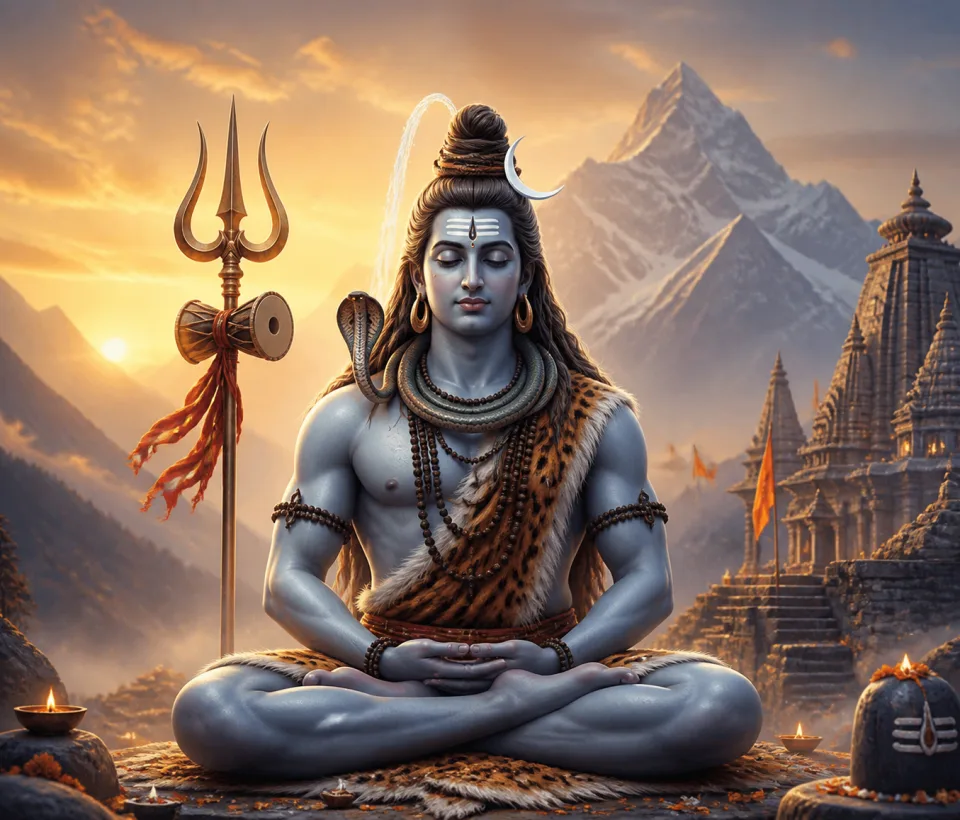
Har Har Har Mahadev explores Shiva through paired contrasts: personal and formless, splendid and ascetic, gentle and formidable. Every stored verse is separated by the same short congregational refrain.
Quick Facts
Har Har Har Mahadev Aarti Lyrics in English
Read the complete source-aligned Aarti in simple Roman script. The recurring refrain is emphasized within the same continuous sequence.
Aarti and Refrain
Har har har mahadev!
Saty, sanatan, sundar, shiv sabake svami
Avikari avinashi, aj antaryami
Har har har mahadev!
Adi, anant, anamay, akal, kaladhari
Amal, arup, agochar, avichal, aghahari
Har har har mahadev!
Brahma, vishnu, maheshvar tum trimurtidhari
Karta, bharta, dharta, tum hi sanhari
Har har har mahadev!
Rakshak, bhakshak, prerak, priy audharadani
Sakshi, param akarta, karta abhimani
Har har har mahadev!
Manimay-bhavan nivasi, ati bhogi ragi
Sada shmashan vihari, yogi vairagi
Har har har mahadev!
Chhal-kapal, garal-gal, mundamal vyali
Chita bhasmatan trinayan, ayanamahakali
Har har har mahadev!
Pret-pishach-susevit, pit jatadhari
Vivasan vikat rupadhar, rudr pralayakari
Har har har mahadev!
Shubhr-saumy, surasaridhar, shashidhar, sukhakari
Atikamaniy, shantikar, shivamuni man-hari
Har har har mahadev!
Nirgun, sagun, niranyjan, jagamay nity prabho
Kalarup keval har! kalatit vibho
Har har har mahadev!
Sat, chit, anand, rasamay, karunamay dhata
Prem-sudha-nidhi priyatam, akhil vishv trata
Har har har mahadev!
Ham atidin, dayamay! charan-sharan dijai
Sab vidhi nirmal mati kar, apana kar lijai
Har har har mahadev!
Line-by-line Meaning
Meaning in Source Order
The refrain acclaims Shiva: “Har Har Har Mahadev.”
Shiva is praised as truth, eternal beauty, the unchanging and unborn indwelling Lord of all.
The refrain acclaims Shiva: “Har Har Har Mahadev.”
He is beginningless, endless, untouched by illness, beyond form and perception, steady, and the remover of wrongdoing.
The refrain acclaims Shiva: “Har Har Har Mahadev.”
The hymn sees him through the Trimurti as creator, sustainer, bearer of the world, and dissolver.
The refrain acclaims Shiva: “Har Har Har Mahadev.”
He protects, consumes, inspires, and gives freely; he is the witnessing presence beyond action and pride.
The refrain acclaims Shiva: “Har Har Har Mahadev.”
The verse holds together contrasting images: a lord of splendour and a detached yogi who dwells in the cremation ground.
The refrain acclaims Shiva: “Har Har Har Mahadev.”
His fearsome ascetic form bears bark, skulls, poison at the throat, serpents, sacred ash, and three eyes.
The refrain acclaims Shiva: “Har Har Har Mahadev.”
Attended by spirits, the matted-haired Rudra appears unclothed and formidable as the power of dissolution.
The refrain acclaims Shiva: “Har Har Har Mahadev.”
The same Lord is radiant and gentle, bearing Ganga and the moon, bringing peace and captivating contemplative minds.
The refrain acclaims Shiva: “Har Har Har Mahadev.”
He is both without attributes and present through attributes, pervading the world as time yet remaining beyond time.
The refrain acclaims Shiva: “Har Har Har Mahadev.”
Shiva is praised as being, consciousness, bliss, compassion, a treasury of love, and protector of the whole universe.
The refrain acclaims Shiva: “Har Har Har Mahadev.”
The devotee asks the merciful Lord for refuge at his feet, a purified understanding, and acceptance as his own.
The refrain acclaims Shiva: “Har Har Har Mahadev.”
Themes in Har Har Har Mahadev
The Aarti gathers philosophical names and vivid ascetic imagery into one sequence. It ends not with a claim of certainty but with a direct prayer for refuge, clarity, and acceptance.
How Har Har Har Mahadev Is Traditionally Sung
The compact refrain works naturally as a group response after each longer verse. A deliberate pace keeps the many names distinct while preserving the strong Har Har Har Mahadev cadence.
Frequently Asked Questions
The standalone Har Har Har Mahadev refrain appears twelve times around eleven praise verses.
No. It places gentle, cosmic, ascetic, personal, and formless descriptions beside one another.
The singer asks for refuge, a purified mind, and acceptance by the merciful Lord.