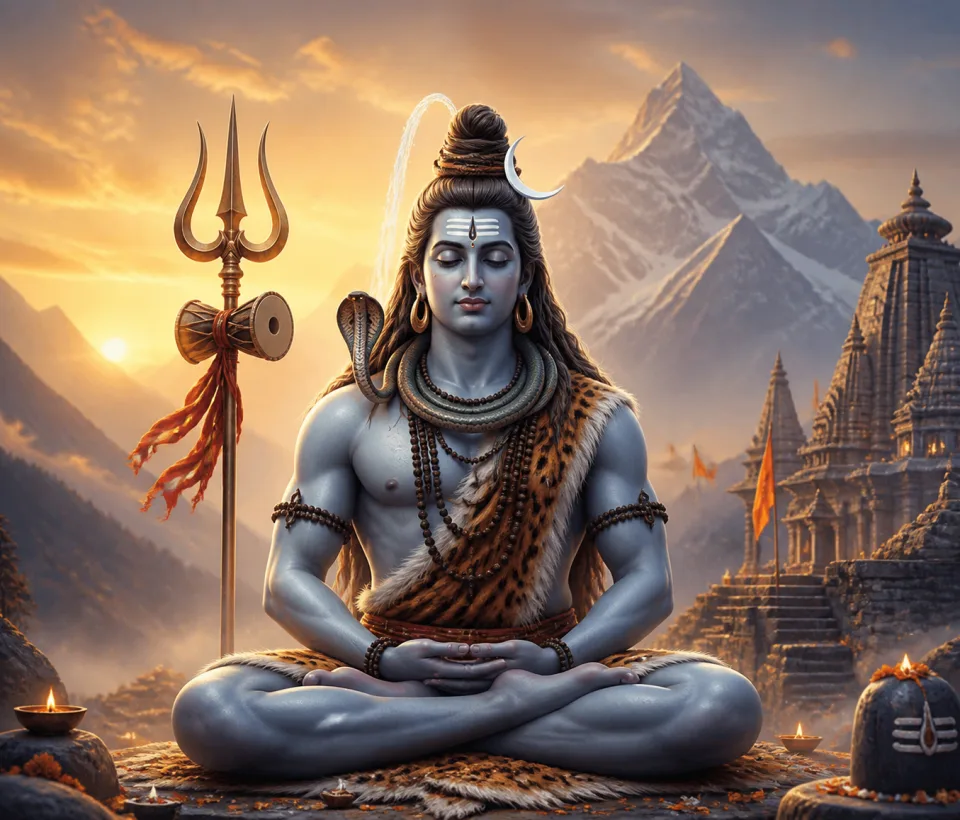
Kailashvasi Aarti begins with Shiva, Ganga, and Parvati and then imagines Kailasa through dance, music, forests, shining mountains, sages, and prayer. Its ten refrains and final completion line remain in source order.
Quick Facts
Kailashvasi Shiva Aarti Lyrics in English
Read the complete source-aligned Aarti in simple Roman script. The recurring refrain is emphasized within the same continuous sequence.
Aarti and Refrain
Shish gang ardhang parvati, sada birajat kailasi
Nandi bhringi nrity karat hain, dharat dhyan sur sukharasi
Jai kailasavasi
Shital mand sugandh pavan bah, baithe hain shiv avinashi
Karat gan gandharv sapt svar, rag ragini madhurasi
Jai kailasavasi
Yaksh-raksh-bhairav jahan dolat, bolat hain banake vasi
Koyal shabd sunavat sundar, bhramar karat hain gunja-si
Jai kailasavasi
Kalpadrum aru parijat taru, lag rahe hain lakshasi
Kamadhenu kotin jahan dolat, karat dugdhaki varsha-si
Jai kailasavasi
Suryakant sam parvat shobhit, chandrakant sam himarashi
Nity chhahon ritu rahat sushobhit, sevat sada prakriti-dasi
Jai kailasavasi
Rishi-muni dev danuj nit sevat, gan karat shruti gunarashi
Brahma-vishnu niharat nisidin, kachhu shiv hamakun pharamasi
Jai kailasavasi
Riddhi siddhi ke data shankar, nit sat chit anandarashi
Jinake sumirat hi kat jati, kathin kal-yamaki phansi
Jai kailasavasi
Trishuladharajika nam nirantar, prem sahit jo nar gasi
Dur hoy bipada us nar ki, janm-janm shivapad pasi
Jai kailasavasi
Kailasi kashike vasi, avinashi meri sudh lijo
Sevak jan sada charananako, apanon jan kripa kijo
Jai kailasavasi
Tum to prabhuji sada dayamay, avagun mere sab dhakiyo
Sab aparadh kshamakar shankar, kinkaraki binati suniyo
Jai kailasavasi
Iti sanpurnanm
Line-by-line Meaning
Meaning in Source Order
Ganga rests upon Shiva’s head and Parvati shares his form as he abides forever on Kailasa.
Nandi and Bhringi dance while the gods meditate upon this treasury of divine joy.
The refrain celebrates Shiva as the eternal Lord who dwells on Kailasa.
A cool, gentle, fragrant breeze moves around the immortal Shiva seated on Kailasa.
Gandharvas sing the seven notes, shaping sweet ragas and raginis.
The refrain celebrates Shiva as the eternal Lord who dwells on Kailasa.
Yakshas, rakshasas, and Bhairavas wander there like inhabitants of the sacred forest.
The cuckoo sings beautifully and bees fill the surroundings with their humming.
The refrain celebrates Shiva as the eternal Lord who dwells on Kailasa.
Wish-fulfilling kalpadruma and parijata trees appear there in countless numbers.
Countless Kamadhenu cows roam there, seeming to shower the land with milk.
The refrain celebrates Shiva as the eternal Lord who dwells on Kailasa.
The mountain gleams like sunstone while its masses of snow shine like moonstone.
All six seasons remain beautifully present, with nature herself serving the Lord.
The refrain celebrates Shiva as the eternal Lord who dwells on Kailasa.
Sages, gods, and other beings continually serve and sing the virtues praised by sacred revelation.
Brahma and Vishnu look on day and night, awaiting Shiva’s command.
The refrain celebrates Shiva as the eternal Lord who dwells on Kailasa.
Shankara, giver of accomplishment and prosperity, is praised as a treasury of being, consciousness, and bliss.
Remembering him is said to cut through the difficult bonds of time and death.
The refrain celebrates Shiva as the eternal Lord who dwells on Kailasa.
The person who lovingly and continually sings the name of the trident-bearing Lord offers true devotion.
The hymn prays that such a devotee’s troubles depart and closeness to Shiva continue across lives.
The refrain celebrates Shiva as the eternal Lord who dwells on Kailasa.
O immortal resident of Kailasa and Kashi, please remember and care for me.
Know me as a servant at your feet, accept me as your own, and show compassion.
The refrain celebrates Shiva as the eternal Lord who dwells on Kailasa.
Merciful Lord, conceal my faults beneath your compassion.
Forgive every offence, Shankara, and hear the prayer of your attendant.
The refrain celebrates Shiva as the eternal Lord who dwells on Kailasa.
Thus the complete Aarti comes to its close.
Kailasa in the Kailashvasi Aarti
Kailasa is portrayed as both a divine landscape and a place of refuge. After its cosmic scenery, the final verses become personal petitions for remembrance, forgiveness, and grace.
How the Kailashvasi Aarti Is Traditionally Sung
The two descriptive lines of each verse can be sung by a leader, followed by the short Jai Kailasavasi response from the group. The closing iti sampoornam is retained as a completion notation, not turned into a new heading.
Frequently Asked Questions
It has ten pairs of descriptive lines, each followed by a standalone refrain, plus a final completion notation.
The hymn imagines Shiva’s abode on Kailasa through natural, musical, and devotional imagery.
It is present in the stored source and simply marks that the text is complete.