Om Jai Gangadhar is a Sanskrit Shiva Aarti whose stored verses move through Kailasa, music and dance, Shiva’s iconography, worship with Vedic recitation, and a final devotional assurance. Each stanza retains Om Har Har Har Mahadev.
Quick Facts
Om Jai Gangadhar Aarti Lyrics in English
Read the complete source-aligned Aarti in simple Roman script. The recurring refrain is emphasized within the same continuous sequence.
Aarti and Refrain
Om Jai gangadhar Jai har,Jai girijadhisha
Tvan man palay nityan,kripaya jagadisha
Om har har har mahadev
Kailase girishikhare,kalpadrumavipine
Gunjati madhukarapunje,kunjavane gahane
Om har har har mahadev
Kokilakujit khelat,hansavan lalita
Rachayati kalakalapan,nrityati mudasahita
Om har har har mahadev
Tasminllalitasudeshe,shala manirachita
Tanmadhye haranikate,gauri mudasahita
Om har har har mahadev
Krida rachayati,bhusharanchit nijamisham
Indradik sur sevat,namayate shisham
Om har har har mahadev
Bibudhabadhu bahu nrityat,hridaye mudasahita
Kinnar gayan kurute,sapt svar sahita
Om har har har mahadev
Dhinakat thai thai dhinakat,mridang vadayate
Kvan kvan lalita venun,madhuran natayate
Om har har har mahadev
Run run charane rachayati,nupuramujjvalita
Chakravarte bhramayati,kurute tan dhik tan
Om har har har mahadev
Tan tan lup chup,tan tan damaru vadayate
Angushthangulinadan,lasakatan kurute
Om har har har mahadev
Kapurradyutigauran,panychananasahitam
Trinayanashashidharamaulin,vishadharakanthayutam
Om har har har mahadev
Sundarajatayakalapan,pavakayutabhalam
Damarutrishulapinakan,karadhritanrikapalam
Om har har har mahadev
Mundai rachayati mala,pannagamupavitam
Vamavibhage girija,rupan atilalitam
Om har har har mahadev
Sundarasakalasharire,kritabhasmabharanam
Iti vrishabhadhvajarupan,tapatrayaharanan
Om har har har mahadev
Shankhaninadan kritva,jhallari nadayate
Nirajayate brahma,vedarichan pathate
Om har har har mahadev
Atimriducharanasarojan,hritkamale dhritva
Avalokayati maheshan,ishan abhinatva
Om har har har mahadev
Dhyanan Aarti samaye,hridaye ati kritva
Ramastrijatanathan,ishan abhinatva
Om har har har mahadev
Sangatimevan pratidin,pathanan yah kurute
Shivasayujyan gachchhati,bhaktya yah shrrinute
Om har har har mahadev
Line-by-line Meaning
Meaning in Source Order
Glory to Gangadhara and Girijadhisha; O Lord of the world, protect me always through your compassion.
On Kailasa’s high peak, in a grove of wish-fulfilling trees, clusters of bees hum through the deep bowers.
Cuckoos call and graceful swans move about while joyful dance and artistic play unfold.
In that lovely region stands a jewel-built hall, where Gauri sits happily beside Hara.
Gauri playfully adorns her Lord while Indra and the other gods serve and bow their heads.
Celestial women dance with joy in their hearts while kinnaras sing through the seven notes.
The mridanga sounds dhinakat thai thai and the sweet flute rings out for the dance.
Bright anklets sound runu-runu at the feet as the dancer turns in circles to rhythmic syllables.
The damaru beats out its patterns while thumb and fingers create the pulse of the graceful dance.
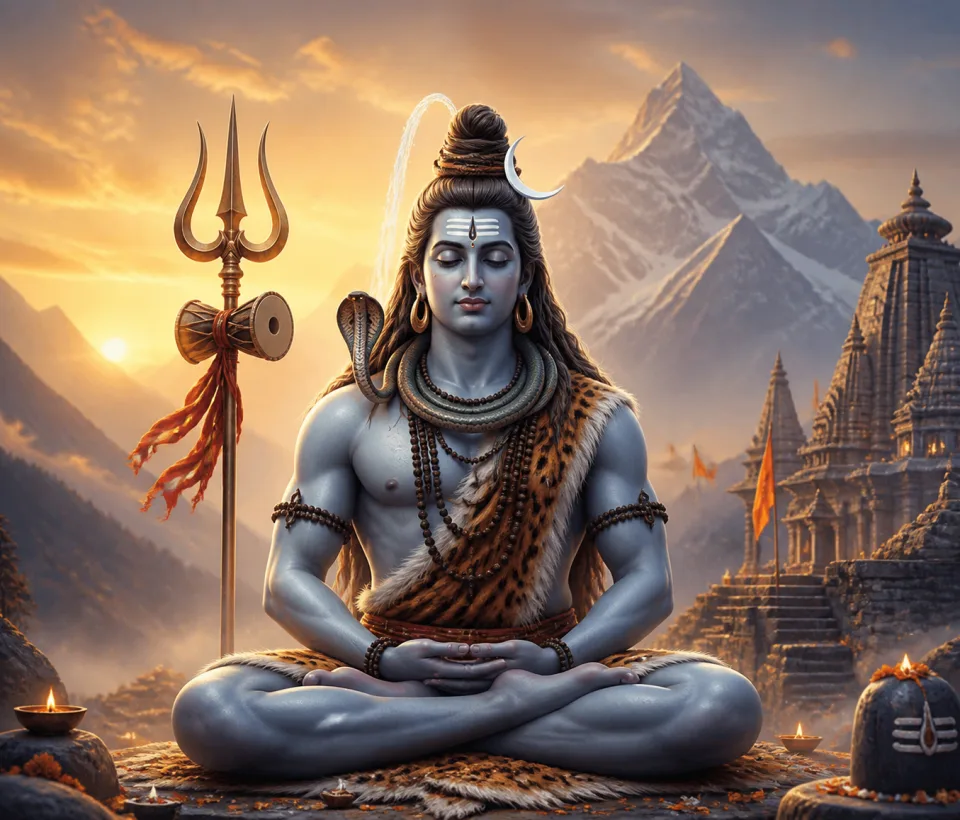
Shiva is radiant like camphor, five-faced and three-eyed, moon-crested, with poison held at his throat.
His beautiful matted hair and fiery brow shine; he holds damaru, trident, bow, and a skull.
He wears a garland of heads and a serpent as sacred thread, while Girija forms his graceful left half.
Sacred ash ornaments his whole body; this bull-bannered form removes the three kinds of suffering.
A conch is sounded and cymbals ring as Brahma performs the lamp offering and recites Vedic verses.
The worshipper holds Shiva’s tender lotus feet in the heart and beholds Mahesha after bowing to him.
At Aarti time, the singer establishes deep meditation in the heart and bows to the Lord of Trijata.
The closing verse says that one who recites this daily and listens with devotion attains closeness to Shiva.
Imagery and Movement in Om Jai Gangadhar
Unlike a short praise song, this Sanskrit Aarti unfolds as a scene: Kailasa becomes a theatre of nature, celestial music, dance, iconography, and formal worship before the meditation turns inward.
How Om Jai Gangadhar Is Traditionally Sung
Its rhythmic syllables invite measured musical delivery. The longer Sanskrit lines can be led slowly, with the assembly joining the Om Har Har Har Mahadev ending preserved in every stanza.
Frequently Asked Questions
Yes. The stored source is a seventeen-stanza Sanskrit Aarti written in Devanagari.
It describes Kailasa, celestial dance and music, Shiva’s form, and a formal lamp offering.
No. Its presence in every stored stanza is retained in the Roman sequence.