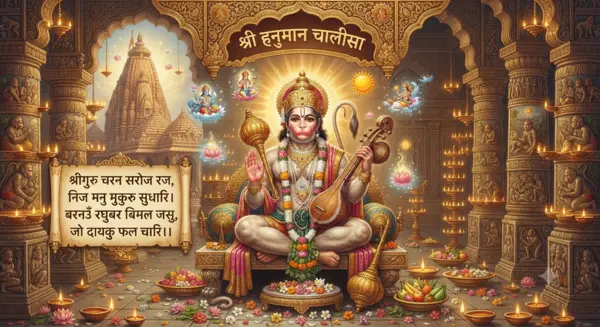

Salasar Balaji Chalisa is a place-centred Hanuman hymn. It praises Salasar as a sacred destination, recounts the service of Mohandas and Uday, describes the red-sindoor image, and welcomes pilgrims who come with flags, coconuts, and churma.
The full stored source has one opening doha, forty main stanzas, and one closing doha. Each stanza remains a single unnumbered Roman unit and receives a source-specific English meaning.
Quick Facts
Salasar Balaji Chalisa Lyrics in English
Read the complete source-linked devotional sequence in simple Roman script.
Opening Doha
Guru gira aru ganapati, puni vinavaun hanuman salasar ke devata, sada karo kalyan
Lal deh ki lalima, murti lal lalam hath jod vinati karun, puravahu sabake kam
Salasar Balaji Chalisa
Jay jay jay salasar dhama pavan ruchir lok abhirama
Jimi pavan mathura aru kasi pushkar kurukshetran sukharasi
Avadhapuri, gange haridvara salasar shubh varanu vichara
Rajasthan sikar niyaraye lachhamanagadh nagar man bhaye
Tehi niyar salasar grama sakal bhanti shubh shuchi sukhadhama
Siddhapith yah param punita hanumad darshan sab dukh bita
Tate vinay karaun sunu bhai bhajahun pavanasut sumati pai
Salasar hanumat jimi ava kahun sakal sunu man samujhava
Mohanadas vipr sab jana bhagati bhav gun jnyan nidhana
Uday sang le khet kamaye ek bar hanumad tahan aye
Kah kapi vipr suno mam bani kije dhyan bhagati jiy jani
Sab taji mohan vipr vichar hanumat bhajan sada sukhakari
Karai bhajan bhagati aru dhyana nity hoi milan hanumana
Asota murti pragataye lai thakur salasar aye
Vikram ashtadas shat gyarah ayau hanumad ravi jimi barah
Shravan sit navami shanivara thayan yog bhumi asavara
Mohan pujan havan karai kapi murati thapi sukhadai
Arati mohan mangal gava dhol nagara shabad suhava
Chadhe churama bhog lagay bhajan kirtan sab mil gaye
Ek bar mohan man bhai bhai prerana murt sajai
Chitr racha jo man sukhadai bhaye prasann hanumat kapirai
Ghrit sindur thal bhar lina murat lal lalit kar dina
Mohan bole uday bulai hanumad kahan avaradhau ai
Sevahun hanumad lagn lagai nit prati bhagati badhai savai
Salasar jayakar suhai chahundishi ghanta dhuni man bhai
Din din ho mandir vistara puja kare uday parivara
Mangal punam jo man bhaye salasar shubh darshan paye
Dhvaja nariyal an chadhaye khand churama bhog lagaye
Hanumat bhajan karai man lai salasar hanuman manai
Ehividhi ai dhok lagaye man ichchha phal sab jan paye
Atm jnyan badhe nit naya jab te hoye hanumat daya
Sab vidh kasht vikar hatave salasar sharana jo jave
Chinta sanpini tako bhaj jake hiy men hanumat raje
Hanumat darshan ati man bhai lal deh chhavi kahi nahin jai
Dur dur te log lugai bade bhag te darshan pai
Karahi saphal sab nij nij lochan kari kari darshan sankat mochan
Hanumat mahima chahundishi gaje salasar hanuman viraje
Salasar shubhadham bhajami jay jay jay bajarang namami
"indrajit" kapirai sahai salasar mahima jo gai
Salasar hanumat chalisa padhe sune shubh kare kapisa
Closing Doha
Chalisa shubhadham ka, gaye jo chitalay 'indrajit' bhagati badhe, daya karen kapiray
Om sumar gate raho, nit Shri sitaram salasar sharana gaho, kari hanumat pranam
Salasar Balaji Chalisa Meaning in English
Opening Doha Meaning
After remembering the guru, Ganesha, and Hanuman, the poet praises Salasar’s red-hued deity and asks for the welfare of all.
Chalisa Meaning
Victory to the sacred realm of Salasar, praised as pure, beautiful, and delightful.
Its holiness is compared with Mathura, Kashi, Pushkar, and Kurukshetra.
Ayodhya, the Ganga, and Haridwar are recalled while the poet turns to describe auspicious Salasar.
The source locates it in Rajasthan near Sikar and the town of Lachhmangarh.
Nearby Salasar village is praised as clean, auspicious, and filled with well-being.
This revered Siddha Pitha is considered deeply holy, and Hanuman’s vision is associated with relief from sorrow.
The poet therefore asks listeners to pray to the son of the Wind and receive sound understanding.
He begins the account of how Hanuman came to be established at Salasar.
Mohandas, known as a Brahmin devotee, is praised as rich in devotion, virtue, and knowledge.
While he works in the field with Uday, Hanuman appears there one day.
Hanuman tells him to listen and cultivate heartfelt attention and devotion.
Mohandas reflects that leaving distraction behind for Hanuman’s worship brings lasting happiness.
Through continuing prayer, devotion, and meditation, he experiences Hanuman’s presence regularly.
A sacred image appears at Asota and is brought by the local ruler to Salasar.
The source dates the manifestation through a traditional Vikram-era reference and compares Hanuman’s arrival to the sun.
It places the event on a Saturday in the bright half of Shravan at an auspicious site.
Mohandas performs worship and fire offering, then establishes the comforting Hanuman image.
He sings an auspicious arati while drums and kettledrums produce a beautiful sound.
Churma is offered, and the community gathers for devotional singing and praise.
A new inspiration arises in Mohandas’s mind concerning the form of the image.
The image is shaped according to the inward vision, and Hanuman is described as pleased.
A tray of ghee and sindoor gives the image its graceful red appearance.
Mohandas calls Uday and invites him to come and worship Hanuman.
Uday serves with concentration, and his devotion is said to increase every day.
Cries of victory and ringing bells spread the joy of Salasar in every direction.
The temple expands over time while Uday’s family continues the worship.
Those who arrive on Tuesday or a full-moon day seek an auspicious vision at Salasar.
Pilgrims bring a flag and coconut and offer sugar and churma.
With an attentive mind they sing Hanuman’s praise and honour Salasar Balaji.
They bow in this manner and bring their heartfelt wishes before the deity.
When Hanuman’s compassion arises, self-knowledge is said to deepen continually.
Those who enter Salasar’s refuge ask that hardship, disorder, and harmful tendencies fall away.
The serpent of anxiety flees from a heart in which Hanuman is firmly established.
The red form seen in darshan delights the mind and is described as beyond adequate words.
Women and men travel from distant places and count themselves fortunate to receive darshan.
By beholding Sankat Mochan, pilgrims feel that their eyes and journeys have become fruitful.
Hanuman’s greatness resounds everywhere as he remains present at Salasar.
The poet worships the auspicious Salasar abode and repeatedly bows to Bajrang.
Indrajit asks the monkey-Lord for help while singing the greatness of Salasar.
The final main stanza says that reading or hearing this Chalisa is directed toward auspiciousness under Hanuman’s care.
Closing Doha Meaning
The poet asks for growing devotion and Hanuman’s mercy, urging remembrance of Sita-Rama and surrender at Salasar.
Salasar Balaji Chalisa: A Hanuman Hymn Rooted in Place
Salasar Balaji devotion belongs to a specific Rajasthan pilgrimage tradition. The hymn itself names Sikar, Lachhmangarh, Salasar village, Asota, Mohandas, Uday, and the red image covered with ghee and sindoor.
Offerings such as a flag, coconut, and churma appear as acts of reverence and communal memory. The deeper movement of the Chalisa is from anxious petition toward service, self-knowledge, and trust.
Main Themes in the Salasar Balaji Chalisa
Sacred place is built through continuing service: manifestation, installation, worship, family stewardship, and pilgrimage all contribute.
Hanuman’s protection is linked with sumati—sound understanding—so courage and discernment grow together.
How to Read the Salasar Balaji Chalisa
Follow the narrative from Salasar’s location through Mohandas’s experience, the image’s installation, and the later pilgrim practices.
Tuesday, Saturday, or a full-moon day may be chosen traditionally, but attentive remembrance of Hanuman and Sita-Rama is central.
Frequently Asked Questions
Yes. This source repeatedly identifies Salasar Balaji with Hanuman, the son of the Wind and Sankat Mochan.
They are central devotees in the source’s account of the manifestation, installation, and continuing service of the image.
The hymn describes ghee and sindoor being applied to give the image its distinctive red appearance.
The source names a flag, coconut, sugar, and churma among pilgrim offerings.