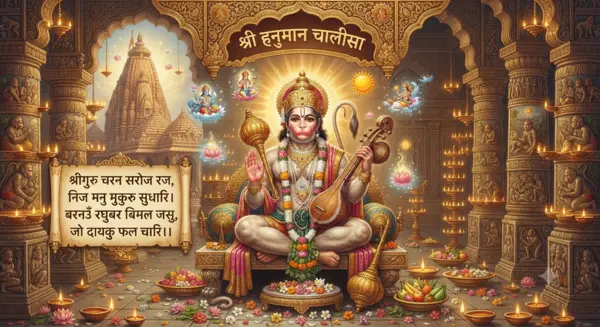
This Balaji Chalisa is centred on Mehandipur Balaji, where Hanuman is praised in a powerful child form alongside the shrine’s traditional guardians. The hymn moves between local devotional imagery and familiar episodes from Hanuman’s service to Rama.
The English page preserves two opening dohas, forty main units, and one closing doha from the Hindi source. Every complete stanza remains a single Roman lyric unit with one matching meaning.
Quick Facts
Balaji Chalisa Lyrics in English
Read the complete source-linked devotional sequence in simple Roman script.
Opening Dohas
Shri guru charan chitalay ke dharen dhyan hanuman
Balaji chalisa likhe das snehi kalyan
Vishv vidit varadani sankat haran hanuman
Mainhadipur men prakat bhaye balaji bhagavan
Balaji Chalisa
Jay hanuman balaji deva, pragat bhaye yahan tinon deva
Pretaraj bhairav balavana, kotaval kaptani hanumana
Mainhadipur avatar liya hai, bhakton ka uddhar kiya hai
Balarup pragate hain yahan par, sankat vale ate jahan par
Dakani shakani aru jindanin, mashan churail bhut bhutanin
Jake bhay te sab bhag jate, syane bhope yahan ghabarate
Chauki bandhan sab kat jate, dut mile anand manate
Sachcha hai darabar tihara, sharan pade sukh pave bhara
Rup tej bal atulit dhama, sanmukh jinake siy rama
Kanak mukut mani tej prakasha, sabaki hovat purn asha
Mahant ganeshapuri gunile, bhaye susevak ram rangile
Adbhut kala dikhai kaisi, kalayug jyoti jalai jaisi
Unchi dhvaja pataka nabh men, svarn kalash hain unnat jag men
Dharm saty ka danka baje, siyaram jay shankar raje
An phiraya mugadar ghota, bhut jind par padate sota
Ram lakshman siy hriday kalyana, bal rup pragate hanumana
Jay hanumant hathile deva, puri parivar karat hain seva
Laddu churama miShri meva, arji darakhast lagau deva
Daya kare sab vidhi balaji, sankat haran pragate balaji
Jay baba ki jan jan uchare, kotik jan tere aye dvare
Bal samay ravi bhakshahi linha, timir may jag kinho tinha
Devan vinati ki ati bhari, chhand diyo ravi kasht nihari
Langhi udadhi siya sudhi laye, lakshman hit sanjivan laye
Ramanuj pran divakar, shankar suvan man anjani chakar
Keshari nandan dukh bhav bhanjan, ramanand sada sukh sandan
Siya ram ke pran piyare, jab baba ki bhakt uchare
Sankat dukh bhanjan bhagavana, daya karahu he kripa nidhana
Sumar bal rup kalyana, kare manorath purn kama
Asht siddhi nav nidhi datari, bhakt jan ave bahu bhari
Meva aru mishthan pravina, bhent chadhaven dhani aru dina
Nrity kare nit nyare nyare, riddhi siddhiyan jake dvare
Arji ka adesh milate hi, bhairav bhut pakadate tabahi
Kotaval kaptan kripani, pretaraj sankat kalyani
Chauki bandhan katate bhai, jo jan karate hain sevakai
Ramadas bal bhagavanta, mainhadipur pragate hanumanta
Jo jan balaji men ate, janm janm ke pap nashate
Jal pavan lekar ghar jate, nirmal ho anand manate
Krur kathin sankat bhag jave, saty dharm path rah dikhave
Jo sat path kare chalisa, tapar prasann hoy bagisa
Kalyan snehi, sneh se gave, sukh samriddhi riddhi siddhi pave
Closing Doha
Mand buddhi mam janake, kshama karo gunakhan
Sankat mochan kshamahu mam, das snehi kalyan
Balaji Chalisa Meaning in English
Opening Dohas Meaning
Meditating on the guru’s feet and Hanuman, the poet Kalyan begins the Balaji Chalisa.
Balaji is praised as the renowned boon-giving Hanuman who removes distress and is manifest at Mehandipur.
Chalisa Meaning
Victory to Balaji Hanuman, at whose sacred place the three revered powers are present.
The powerful Pretaraj and Bhairava serve as guardians under Hanuman’s commanding protection.
Balaji is said to have appeared at Mehandipur for the upliftment of devotees.
He is manifest there in child form, and people carrying heavy troubles approach his refuge.
The source names many feared spirits and unseen disturbances within its traditional protective language.
All such forces flee before Balaji, and even ritual specialists are awed by his authority.
Bindings and obstructions are cut, while the divine attendants rejoice in restored freedom.
His court is called true; those who surrender there seek deep comfort and support.
His form is a dwelling of unmatched brilliance and strength, with Sita and Rama before him.
A golden, jewel-bright crown shines upon him, and devotees bring their hopes to his presence.
The hymn honours Mahant Ganeshpuri and the devoted servant Ram, absorbed in divine love.
Their service reveals a wondrous spiritual skill, compared with a lamp lit in the present age.
A high flag flies in the sky and a golden finial marks the shrine’s prominence.
The proclamation of truth and dharma resounds with praise of Sita-Rama and Shiva.
Balaji raises and turns his heavy mace, striking fear into harmful forces.
Rama, Lakshmana, and Sita dwell in his auspicious heart as Hanuman appears in child form.
Victory to the resolute Lord Hanuman, served at the sacred place by an entire devotional community.
Devotees offer laddus, churma, sweets, and dry fruits while presenting their heartfelt petitions.
Balaji shows mercy in every way and appears specifically as the remover of distress.
People everywhere cry victory to Baba, and countless visitors gather at his door.
The hymn recalls young Hanuman swallowing the sun and leaving the world in darkness.
The gods plead earnestly, and he releases the sun after seeing their suffering.
He crosses the ocean, finds Sita, and later brings the life-restoring herb for Lakshmana.
As Anjani’s son and Shiva’s child, he restores Lakshmana, the younger brother of Rama.
Kesari’s son removes worldly sorrow and continually carries the joy of Rama.
He is dear to Sita and Rama, and devotees lovingly call upon him as Baba.
The prayer asks the compassionate Lord to break distress, sorrow, and every oppressive burden.
Remembering his auspicious child form, devotees ask him to bring worthy aims to completion.
He gives the eight attainments and nine treasures, and large numbers of devotees approach him.
Rich and poor alike bring sweets and dry fruits, placing offerings without social distinction.
Distinct forms of devotional celebration unfold where prosperity and spiritual attainment attend his door.
When an order is received in response to a petition, Bhairava is described as seizing the troubling force.
The guarding officers and Pretaraj stand for the shrine’s power to restore order amid distress.
Those who serve there trust that restrictive bonds and ritual obstructions will be cut.
The source remembers the servant Ramdas and Hanuman’s powerful manifestation at Mehandipur.
Visitors to Balaji seek release from the burden of wrongdoing carried across many births.
They take sanctified water home with a clearer heart and a renewed sense of joy.
Harsh trouble is asked to depart as truth and dharma reveal a steadier way forward.
The hymn says Balaji is pleased with one who completes the Chalisa faithfully.
The poet Kalyan sings with affection and prays for well-being, abundance, and spiritual accomplishment.
Closing Doha Meaning
Knowing the poet’s limited understanding, the treasure-house of virtues is asked to forgive and remove distress.
Balaji Chalisa: Hanuman in the Devotional World of Mehandipur
Balaji is a widely used devotional name, and this particular source clearly identifies the Mehandipur manifestation of Hanuman. Pretaraj and Bhairava appear within the local sacred order described by the hymn.
Its language about spirits and bindings reflects religious belief and pilgrimage practice. Mental or physical health concerns should still receive appropriate professional care rather than being treated through recitation alone.
Main Themes in the Balaji Chalisa
Refuge is open to rich and poor alike: offerings differ, but sincerity and a turn toward truth are the qualities emphasized.
Hanuman’s local Balaji form remains connected with the Ramayana virtues of service, courage, loyalty, and life-restoring effort.
How to Read the Balaji Chalisa
Use the meanings to distinguish the Mehandipur references from the Ramayana episodes in the second half of the Chalisa.
Tuesday or Saturday may be chosen traditionally, but calm reading and responsible care for any real-world distress are more important than fear.
Frequently Asked Questions
The source praises Hanuman in the child-form manifestation associated with Mehandipur Balaji.
Pretaraj and Bhairava appear as guardians within the shrine’s traditional devotional account.
No. It explains the source’s devotional language without promising a cure or a guaranteed outcome.
The hymn recalls the sun episode, crossing the ocean, finding Sita, and bringing the life-restoring herb for Lakshmana.