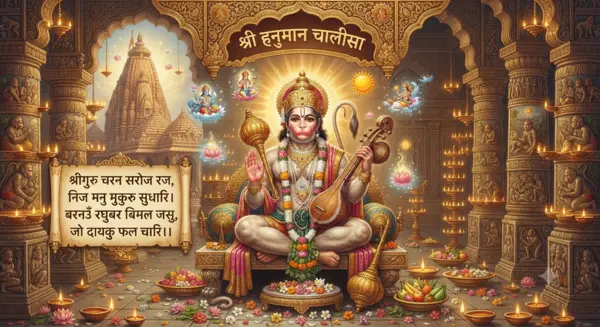
The Hanuman Chalisa is a beloved Hindu devotional composition honoring Lord Hanuman, remembered for courage, wisdom, humility, and unwavering service to Lord Rama. Traditionally attributed to Goswami Tulsidas, it praises Hanuman’s character while recalling important moments connected with Rama, Sita, and Lakshmana.
This page presents the complete lyrics in readable English script, followed by simple numbered meanings for every passage. Readers who are new to Hindi devotional literature can begin with the lyrics, understand each verse, and then explore the background, themes, and common recitation traditions.
Quick Facts
Hanuman Chalisa Lyrics in English
Read the Chalisa as one continuous devotional text, from the opening dohas through the complete Chalisa to the closing doha.
Opening Dohas
Shri Guru Charan Saroj Raj
Nij manu mukur sudhari
Baranau Raghuvar bimal jasu
Jo dayaku phal chari
Buddhihin tanu janike
Sumirau Pavan Kumar
Bal buddhi vidya dehu mohi
Harahu kalesh vikar
Hanuman Chalisa
Jai Hanuman gyan gun sagar
Jai Kapis tihun lok ujagar
Ramdoot atulit bal dhama
Anjani putra Pavan sut naam
Mahabir Bikram Bajrangi
Kumati nivar sumati ke sangi
Kanchan varan viraj subesa
Kanan kundal kunchit kesa
Hath bajra aur dhwaja birajai
Kandhe moonj janeu sajai
Shankar suvan Kesari nandan
Tej pratap maha jag vandan
Vidyavan guni ati chatur
Ram kaj karibe ko aatur
Prabhu charitra sunibe ko rasiya
Ram Lakhan Sita man basiya
Sukshma roop dhari Siyahi dikhava
Vikat roop dhari Lanka jarava
Bhim roop dhari asur sanhare
Ramchandra ke kaj sanvare
Laye Sanjivan Lakhan jiyaye
Shriraghubira harashi ur laye
Raghupati kinhi bahut badai
Tum mam priya Bharat-hi sam bhai
Sahas badan tumharo jas gave
As kahi Shripati kanth lagave
Sanakadik Brahmadi munisa
Narad Sarad sahit Ahisa
Yam Kuber Digpal jahan te
Kavi kovid kahi sake kahan te
Tum upkar Sugrivahin kinha
Ram milaye raj pad dinha
Tumharo mantra Vibhishana man
Lankeshvara bhaye sab jag jana
Yug sahasra yojana par bhanu
Lilyo tahi madhur phal janu
Prabhu mudrika meli mukh mahi
Jaladhi laghi gaye acharaj nahi
Durgam kaj jagat ke jete
Sugam anugrah tumhare tete
Ram duare tuma rakhvare
Hot na agya binu paisare
Sab sukh lahai tumhari sarna
Tum rakshaka kahu ko dar na
Aapan teja samharo aapai
Teenon lok hank te kanpai
Bhoot pishach nikat nahi aavai
Mahabir jab naam sunavai
Nasai rog harai sab peera
Japat nirantar Hanumat beera
Sankat te Hanuman chhudavai
Man kram vachan dhyan jo lavai
Sab par Ram tapasvi raj
Tin ke kaj sakal tuma saja
Aur manorath jo koi lavai
Soi amit jeevan phal pavai
Charon yug partap tumhara
Hai prasiddh jagat ujiyara
Sadhu sant ke tuma rakhvare
Asur nikandan Ram dulare
Ashta siddhi nav nidhi ke data
As bar din Janki Mata
Ram rasayan tumhare paas
Sada raho Raghupati ke das
Tumhare bhajan Ram ko pavai
Janam janama ke dukh bisravai
Ant kaal Raghubar pur jai
Jahan janma Hari bhakt kahai
Aur devta chitt na dharai
Hanumat sei sarva sukh karai
Sankat katai mitai sab peera
Jo sumirai Hanumat balbeera
Jai jai jai Hanuman Gosai
Kripa karahu Gurudev ki nai
Jo sat bar path kar koi
Chhutahi bandi maha sukh hoi
Jo yah padhe Hanuman Chalisa
Hoye siddhi sakhi Gaurisa
Tulsidas sada Hari chera
Kijai Nath hriday maha dera
Closing Doha
Pavan tanay sankata haran, mangal murti roop
Ram Lakhan Sita sahit, hriday basahu sur bhoop
Hanuman Chalisa Meaning in English
Back to LyricsEach explanation follows the lyrics above in the same uninterrupted sequence. Devotional statements about protection, relief, and attainment are explained within the traditional voice of the hymn rather than as guaranteed outcomes.
Opening Dohas Meaning
After cleansing the mirror of the mind with the dust of the teacher’s lotus feet, the poet begins to describe the stainless glory of Lord Rama, which leads toward the four traditional aims of life.
Recognizing his own limitations, the poet remembers the Son of the Wind and asks for strength, discernment, and learning, as well as freedom from distress and inner faults.
Chalisa Meaning
Victory to Hanuman, ocean of wisdom and virtue; victory to the lord of the vanaras, whose renown illumines the three worlds.
You are Rama’s messenger and the abode of incomparable strength. You are known as the son of Anjani and the Son of the Wind.
You are the great hero, mighty and firm as the thunderbolt. You dispel harmful understanding and accompany those of good judgment.
Your golden-hued form shines in graceful attire; earrings adorn your ears and your hair is curled.
The thunderbolt and banner shine in your hands, while the sacred thread of munja grass rests upon your shoulder.
You are praised as the son of Shankara and the joy of Kesari. The whole world reveres your radiance and valor.
Learned, virtuous, and exceptionally skillful, you are always eager to carry out the work of Lord Rama.
You delight in listening to the deeds of the Lord. Rama, Lakshmana, and Sita dwell within your heart.
You assumed a subtle form to appear before Sita, and a formidable form when you set Lanka ablaze.
Taking a fearsome form, you defeated hostile forces and brought Lord Rama’s purposes to completion.
You brought the life-restoring herb and revived Lakshmana; the delighted Lord of the Raghu line embraced you.
Rama praised you greatly and declared that you were as dear to him as his brother Bharata.
Countless voices sing your glory; speaking these words, the Lord draws you into an embrace.
Sanaka and the other sages, Brahma and the great seers, Narada, Saraswati, and the lord of serpents all praise you.
Yama, Kubera, the guardians of the directions, poets, and scholars cannot fully express the extent of your greatness.
You helped Sugriva by bringing him to Rama, and through that meeting he regained his royal position.
Vibhishana accepted your counsel and became lord of Lanka—an episode known throughout the world.
The hymn recalls the childhood story in which you saw the distant sun and reached for it, thinking it a sweet fruit.
Carrying the Lord’s ring securely, you crossed the ocean; for one endowed with your strength, the deed is praised as no surprise.
All the difficult tasks of the world become approachable through your gracious help.
You stand watch at Rama’s doorway; the verse portrays entry as taking place only with your permission.
Those who seek your refuge receive comfort; with you as protector, the devotee is encouraged to let go of fear.
You alone can restrain your immense power, and the hymn says that your mighty call makes the three worlds tremble.
Within the hymn’s devotional imagery, troubling spirits do not draw near when the name of the great hero is spoken.
The verse associates continuous remembrance of brave Hanuman with relief from illness and pain; this is a devotional affirmation, not a substitute for medical care.
Hanuman frees from distress those who direct mind, action, and speech toward attentive remembrance.
Rama, the ascetic king, is supreme over all; you faithfully accomplished every task entrusted by him.
The hymn says that whoever brings a heartfelt aspiration receives abundant fruit in life, expressing devotional hope rather than a transactional guarantee.
Your glory is said to extend through all four ages, and your renown brings light to the world.
You protect sages and saints, overcome destructive forces, and remain deeply beloved of Rama.
Mother Janaki granted you the capacity to bestow the eight siddhis and nine treasures, as the hymn recounts.
You hold the sustaining essence of devotion to Rama and remain forever the servant of the Lord of the Raghu line.
Through devotion to you, one is led toward Rama and learns to release sorrows carried across many lives.
At life’s end, the devotee is envisioned as reaching Rama’s abode and being born in devotion to Hari.
The verse expresses single-minded devotion: one who serves Hanuman need not scatter the mind elsewhere and finds spiritual well-being in that service.
The hymn again associates remembrance of powerful Hanuman with the easing of distress and pain.
Victory, victory, victory to Lord Hanuman. The poet asks him to show compassion in the manner of a revered teacher.
The hymn praises repeated recitation as a path from bondage toward great joy. Its mention of one hundred recitations is part of the text, not a universal rule imposed on every reader.
Whoever reads this Hanuman Chalisa is promised spiritual accomplishment within the hymn, with Lord Shiva invoked as witness.
Tulsidas declares himself always a servant of Hari and asks Hanuman to make a dwelling in his heart.
Closing Doha Meaning
O Son of the Wind, remover of distress and embodiment of auspiciousness, dwell in my heart together with Rama, Lakshmana, and Sita.
What Is the Hanuman Chalisa?
The Hanuman Chalisa is a compact work of praise centered on Lord Hanuman’s qualities and actions. It recalls his journey to Lanka, his meeting with Sita, his help to Sugriva and Vibhishana, and his role in bringing the life-restoring herb for Lakshmana. Rather than retelling the Ramayana as a continuous narrative, the composition uses these episodes to present strength guided by judgment, humility, and faithful service.
Within Hindu devotional life, many readers approach the Chalisa as prayer and remembrance. For someone unfamiliar with the tradition, it is also an accessible introduction to Hanuman’s importance in devotion to Lord Rama.
Who Wrote the Hanuman Chalisa?
The Hanuman Chalisa is traditionally attributed to Goswami Tulsidas, the poet-saint closely associated with devotion to Lord Rama and the Ramcharitmanas. The closing verse names Tulsidas and presents him as a servant of Hari. This received attribution can be stated clearly without turning the section into an extended biography.
Why Is It Called a Chalisa?
The word chalisa is connected with the Hindi word for forty. Its central sequence contains forty principal verses, with each verse traditionally described as a chaupai. Two opening dohas introduce the prayer, and one closing doha concludes it.
Main Themes of the Hanuman Chalisa
Devotion
Hanuman’s abilities remain dedicated to Lord Rama rather than personal status.
Courage
Fearless action appears alongside responsibility, purpose, and self-control.
Wisdom
Learning and sound judgment guide strength throughout the remembered episodes.
Service
Devotion becomes practical through carrying messages, crossing obstacles, and helping others.
Humility
Great deeds never separate Hanuman from loyalty or the role of a devoted servant.
Remembrance
The hymn repeatedly turns attention toward Hanuman and, through him, toward Lord Rama.
Hanuman Chalisa in Devotional Tradition
Traditionally, devotees relate to the Chalisa as both praise and prayer. Many associate its recitation with courage during difficulty, steadiness of mind, remembrance of Hanuman, and devotion to Lord Rama. These associations belong to the religious life of the text and should not be converted into guaranteed medical, financial, or worldly outcomes.
Practices differ across families and communities. Some people recite it privately, while others read or sing it in a group. The shared emphasis is attentive remembrance rather than one universally prescribed routine.
How to Read the Hanuman Chalisa
- Read attentively at a comfortable pace instead of rushing through the lines.
- Use the English-script lyrics if you cannot yet read Devanagari.
- Read the meanings in the same sequence to understand what each passage expresses.
- Listen to an established recitation or teacher if you would like to improve pronunciation.
- No repetition count is universally mandatory; one careful reading is a practical beginning.
When Can the Hanuman Chalisa Be Read?
It may be read on any day and at a time that allows focused, respectful attention. Tuesday and Saturday are commonly associated with Hanuman devotion in many traditions, but they are customs rather than requirements that bind every reader. Morning and evening are both common choices.
Pronunciation Help
The lyrics use simple, familiar Roman spelling without scholarly accent marks. Read slowly and listen to an established recitation or teacher if you would like to improve pronunciation.
Hanuman Chalisa vs Hanuman Mantra
The Hanuman Chalisa is a longer devotional composition containing praise, remembered events, and forty principal verses. A Hanuman mantra is generally a shorter sacred formula or invocation used for focused repetition, depending on the tradition. The two forms are different, and the Hanuman Chalisa is not a Vedic mantra.
Frequently Asked Questions
It is a devotional composition praising Lord Hanuman. The sequence presented here includes two opening dohas, forty principal verses, and a closing doha.
The Hanuman Chalisa is traditionally attributed to Goswami Tulsidas, the poet-saint associated with devotion to Lord Rama.
The title refers to a forty-verse devotional composition dedicated to Lord Hanuman. The word chalisa is associated with the number forty.
Its central sequence contains forty principal verses. The opening and closing dohas frame that sequence.
Yes. The English-script lyrics help readers who do not read Devanagari, while the numbered meanings explain each corresponding passage.
Yes. Begin slowly, follow the verse numbers, and use the meaning section to understand the ideas expressed in the lyrics.
Many devotees read it daily, but daily recitation is a personal devotional practice rather than a universal obligation.
No single count is mandatory for every reader. One attentive recitation is a practical starting point.
No. It is a longer devotional Chalisa. A mantra is generally a shorter sacred formula used for focused repetition.
No. The English-script lyrics and verse meanings offer an accessible starting point, while learning more about the language and tradition can deepen understanding.