
The Ganesh Chalisa is a devotional composition honoring Lord Ganesha as the giver of wisdom, the guardian of auspicious beginnings, and the remover of obstacles. Its verses describe his familiar form, remember stories connected with his birth and elephant head, and celebrate the insight that makes him worthy of first worship.
This page presents the complete sequence in simple Roman script, followed by clear English meanings and concise background for readers approaching the text for prayer, study, or cultural understanding.
Quick Facts
Ganesh Chalisa Lyrics in English
Read the complete devotional sequence in simple Roman script, from the opening doha through the central Chalisa to the two closing dohas.
Opening Doha
Jai Ganpati sadgun sadan, kavivar badan kripal
Vighna haran mangal karan, jai jai Girijalal
Ganesh Chalisa
Jai jai jai Ganpati Raju
Mangal bharan karan shubh kaju
Jai Gajbadan sadan sukhdata
Vishva Vinayak buddhi vidhata
Vakra tund shuchi shund suhavan
Tilak tripund bhal man bhavan
Rajit mani muktan ur mala
Swarna mukut shir nayan vishala
Pustak pani kuthar trishulam
Modak bhog sugandhit phoolam
Sundar pitambar tan sajit
Charan paduka muni man rajit
Dhani Shivsuvan Shadanan bhrata
Gauri lalan vishva-vidhata
Riddhi Siddhi tav chanvar sudhare
Mushak vahan sohat dware
Kahaun janma shubh katha tumhari
Ati shuchi pavan mangal kari
Ek samay Giriraj Kumari
Putra hetu tap kinha bhari
Bhayo yagya jab purna anoopa
Tab pahunchyo tum dhari dvij roopa
Atithi jani kai Gauri sukhari
Bahu vidhi seva kari tumhari
Ati prasanna hvai tum var dinha
Matu putra hit jo tap kinha
Milahi putra tuhi buddhi vishala
Bina garbha dharan yahi kala
Gananayak gun gyan nidhana
Pujit pratham roop Bhagwana
Asa kahi antardhyan roop hvai
Palana par balak swaroop hvai
Bani shishu rudan jabahi tum thana
Lakhi mukh sukh nahin Gauri samana
Sakal magan sukh mangal gavahin
Nabh te suran suman varsavahin
Shambhu Uma bahu dan lutavahin
Sur muni jan sut dekhan avahin
Lakhi ati anand mangal saja
Dekhan bhi aaye Shani Raja
Nij avagun guni Shani man mahin
Balak dekhan chahat nahin
Girija kachhu man bhed badhayo
Utsav mor na Shani tuhi bhayo
Kahan lage Shani man sakuchai
Ka karihau shishu mohi dikhai
Nahin vishvas Uma kar bhayau
Shani son balak dekhan kahyau
Padatahin Shani drig kon prakasha
Balak shir udi gayo akasha
Girija girin vikal hvai dharani
So dukh dasha gayo nahin varani
Hahakar machyo Kailasha
Shani kinhyon lakhi sut ko nasha
Turat Garud chadhi Vishnu sidhaye
Kati chakra so gaj shir laye
Balak ke dhad upar dharayo
Pran mantra padhi Shankar darayo
Nam Ganesh Shambhu tab kinhe
Pratham pujya buddhi nidhi var dinhe
Buddhi pariksha jab Shiv kinha
Prithvi ki pradakshina linha
Chale Shadanan bharami bhulai
Rachi baith tum buddhi upai
Charan matu-pitu ke dhar linhen
Tinke sat pradakshin kinhen
Dhani Ganesh kahi Shiv hiya harshe
Nabh te suran suman bahu barse
Tumhari mahima buddhi badai
Shesh sahas mukh sakai na gai
Main mati heen malin dukhari
Karahun kaun bidhi vinay tumhari
Bhajat Ramsundar Prabhudasa
Lakh Prayag Kakara Durvasa
Ab Prabhu daya din par kijai
Apni shakti bhakti kuchh dijai
Closing Dohas
Shri Ganesh yah Chalisa, path karen dhar dhyan
Nit nav mangal griha basai, lahe jagat sanman
Samvat apan sahasra dash, Rishi Panchami Dinesh
Puran Chalisa bhayo, Mangal Murti Ganesh
Ganesh Chalisa Meaning in English
Back to LyricsThe explanations follow the lyric groups in the same order. Traditional statements about auspiciousness and the removal of obstacles are presented as part of the hymn’s devotional voice, not as guaranteed worldly outcomes.
Opening Doha Meaning
The opening salutes Ganesha as the home of noble qualities, gracious toward poets and speakers, the remover of obstacles, the bringer of auspiciousness, and the beloved son of Girija, another name for Parvati.
Chalisa Meaning
The hymn begins with repeated praise of Lord Ganesha, honored as the leader of the ganas and as the one who fills worthy undertakings with an auspicious beginning.
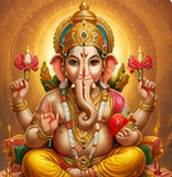
Ganesha is praised in his elephant-faced form as a giver of happiness, the universal Vinayaka, and a divine source of wisdom and understanding.
His curved trunk is described as pure and graceful, while the tilak and three sacred lines on his forehead make his appearance especially pleasing.
Jewels and pearls adorn his chest, a golden crown rests on his head, and his large eyes give his form a majestic presence.
The verse pictures a book, an axe, and a trident in his hands, with modaks and fragrant flowers offered before him.
Ganesha wears beautiful yellow garments, and even sages hold his feet and sandals in loving reverence.
He is celebrated as the son of Shiva, the brother of six-faced Kartikeya, and the cherished child of Gauri.
Riddhi and Siddhi attend him with ceremonial fans, while his mouse vehicle waits at the doorway.
The hymn now turns from description to the sacred story of Ganesha’s birth, calling it pure and auspicious.
Parvati, the daughter of the mountain king, undertakes deep spiritual discipline because she longs for a son.
When her rite is complete, a divine visitor arrives in the form of a learned Brahmin.
Gauri welcomes the visitor as an honored guest and serves him with warmth and care.
Pleased by her devotion, the visitor grants a blessing connected with the son for whom she has performed austerities.
She is promised a son of extraordinary intelligence who will appear without an ordinary birth, as the hymn tells the story.
The promised child will lead the ganas, embody virtue and knowledge, and receive worship before other divine forms.
After speaking the blessing, the visitor disappears and a baby is found resting in the cradle.
The infant begins to cry, and Gauri’s joy at seeing his face is beyond comparison.
Everyone joins in songs of happiness and auspicious celebration as the gods shower flowers from the sky.
Shiva and Uma give generously, while gods, sages, and other visitors come to see their child.
Amid the joyful celebration, Shani also arrives to see the newborn.
Knowing the troubling power associated with his gaze, Shani is reluctant to look directly at the child.
Girija wonders why Shani appears unwilling to share in her celebration.
Shani answers with hesitation, expressing fear about what may happen if the child is shown to him.
Uma does not accept the warning and asks Shani to look at the baby.
When the edge of Shani’s gaze falls upon the child, the hymn says that the baby’s head flies into the sky.
Overcome by grief, Girija falls to the ground; the depth of her sorrow is described as impossible to express.
A cry of distress spreads through Kailash as the terrible result of Shani’s glance becomes clear.
Vishnu immediately departs upon Garuda and returns with the head of an elephant.
The elephant head is placed upon the child’s body, and Shiva restores life through sacred invocation.
Shiva names the child Ganesha, grants him the honor of being worshipped first, and blesses him as a treasury of wisdom.
The hymn next recalls a test of intelligence in which Shiva asks for a journey around the earth.
Kartikeya sets out on the physical journey, while Ganesha calmly forms a thoughtful solution.
Ganesha honors his mother and father as his whole world and circles them seven times.
Shiva rejoices at Ganesha’s insight and praises him, while flowers again fall from the heavens.
The poet says that Ganesha’s greatness and wisdom are so vast that even the thousand mouths of Shesha could not fully sing them.
The speaker approaches with humility, admitting personal limitations and wondering how to offer praise worthy of Ganesha.
This traditional attribution verse remembers Ramsundar Prabhudas and names Prayag, Kakara, and Durvasa within the received text.
The final prayer asks Ganesha to show compassion to the humble and to grant the strength and devotion needed for spiritual life.
Closing Dohas Meaning
The first closing doha commends attentive recitation of the Ganesh Chalisa and expresses the traditional hope that auspiciousness and respect will dwell in the devotee’s home.
The final doha preserves a traditional reference to the completion of the composition and closes by praising Ganesha as Mangal Murti, the embodiment of auspiciousness.
What Is the Ganesh Chalisa?
The Ganesh Chalisa is a hymn of praise centered on Ganesha’s appearance, family, wisdom, and place in Hindu devotional life. The Hindi source preserved by DharmKosh opens with a doha, continues through thirty-eight principal couplets, and concludes with two dohas. The name identifies it with the Chalisa tradition, while this edition follows the actual sequence found in that source rather than adding or numbering verses.
The composition moves from visual praise into narrative. It remembers Parvati’s longing for a child, the celebration of Ganesha’s birth, the episode of Shani’s gaze, the restoration of the child with an elephant head, and Ganesha’s intelligent response to Shiva’s test.
Who Is Lord Ganesha?
Lord Ganesha is one of the most widely honored deities in Hindu tradition. He is recognized by his elephant head and is commonly remembered before a new undertaking, a journey, a ceremony, or a period of study. Devotional traditions associate him with wisdom, discernment, auspicious beginnings, and the ability to move through obstacles.
The Chalisa also places him within a divine family: he is the son of Shiva and Parvati and the brother of Kartikeya. These relationships are not merely biographical details; they shape the stories through which the hymn presents Ganesha’s intelligence, humility, and sacred status.
Stories Remembered in the Ganesh Chalisa
The longest narrative describes Ganesha’s birth and the events leading to his elephant-headed form. The hymn tells how Parvati receives the promise of a wise son, how the divine child appears, and how a joyful gathering is transformed by the feared power of Shani’s gaze. Vishnu brings an elephant head, and Shiva restores the child to life before granting him the name Ganesha and the honor of first worship.
A second episode presents wisdom through action. While Kartikeya begins a journey around the physical world, Ganesha understands his parents as his whole world and circles them instead. The story praises insight that sees the heart of a task rather than following only its outward form.
Main Themes of the Ganesh Chalisa
Auspicious Beginnings
Ganesha is remembered before worthy work as a sign of thoughtful and prayerful beginning.
Wisdom
The hymn values discernment, especially in the story of Ganesha’s response to Shiva’s test.
Sacred Form
The elephant face, curved trunk, ornaments, book, offerings, and mouse vehicle shape the opening praise.
Divine Family
Stories involving Parvati, Shiva, Kartikeya, Shani, and Vishnu place Ganesha within a larger sacred world.
Humility
The closing prayer approaches Ganesha modestly and asks for compassion, strength, and devotion.
Devotional Remembrance
Reading becomes a way to remember Ganesha’s qualities and bring attention back to spiritual purpose.
Ganesh Chalisa in Devotional Tradition
Many devotees read or sing the Ganesh Chalisa as an expression of reverence before beginning something important. Wednesday is commonly associated with Ganesha, and the hymn may also be included in observances around Ganesh Chaturthi. Customs differ across homes, temples, and regions, so no single schedule is universal.
The language of the hymn connects Ganesha with auspiciousness, wisdom, and the removal of obstacles. These are devotional meanings and traditional hopes. They should not be converted into promises of guaranteed success, health, wealth, or any other specific result.
How to Read the Ganesh Chalisa
- Choose a calm time and read attentively rather than rushing through the lines.
- Use the Roman lyrics if you do not yet read Devanagari.
- Pause at the three lyric groups so the opening, central Chalisa, and closing remain clear.
- Read the corresponding meaning groups to understand the images, stories, and prayer.
- Listen to an established recitation or teacher if you want additional pronunciation guidance.
When Can the Ganesh Chalisa Be Read?
The Ganesh Chalisa may be read on any day when you can give it respectful attention. Morning and evening are both common choices. Wednesday and Ganesh Chaturthi carry a special association with Ganesha in many communities, but they are devotional customs rather than restrictions on other days.
Some readers turn to the hymn before study, travel, a ceremony, or a new project. Others include it in a regular prayer routine. A simple, attentive reading is sufficient; an elaborate arrangement is not required.
Pronunciation Help
The lyrics use familiar Roman spelling without scholarly accent marks. Read each line at a comfortable pace. Combinations such as sh, ch, dh, and bh represent sounds commonly heard in Hindi recitation. Listening to a trusted recitation can help with rhythm and unfamiliar names.
Ganesh Chalisa and Ganesh Puja
The Ganesh Chalisa is a devotional text that can be read or sung. Ganesh puja is a broader ritual practice that may include offerings, invocations, mantra, arati, and other steps according to a particular tradition. The Chalisa can be included within a puja, but the two are not identical.
Frequently Asked Questions
The Ganesh Chalisa is a devotional composition praising Lord Ganesha through an opening invocation, a central sequence of praise and sacred stories, and closing dohas.
The Hindi source used for this edition contains one opening doha, thirty-eight principal couplets, and two closing dohas.
Yes. These simple Roman-script lyrics are intended for readers who do not read Devanagari, and the meaning section explains the sequence in natural English.
The Chalisa recalls the tradition in which Shiva grants Ganesha the honor of receiving worship first and blesses him as a treasury of wisdom.
It may be read on any day at a time that supports calm attention. Wednesday and Ganesh Chaturthi are especially associated with Ganesha in many communities.
No elaborate ritual is required for a personal reading. A respectful setting and attentive intention are a practical beginning.
No. It is a longer devotional composition. A mantra is generally a shorter sacred formula used for focused repetition.
The hymn recalls Ganesha’s birth, the episode involving Shani’s gaze and the elephant head, and the wisdom test in which Ganesha circles his parents.
Yes. Beginners can read slowly, follow the three lyric groups, and then use the matching meaning groups for context.
No. The Roman lyrics support pronunciation, while the English meanings and background sections explain the devotional ideas and stories.