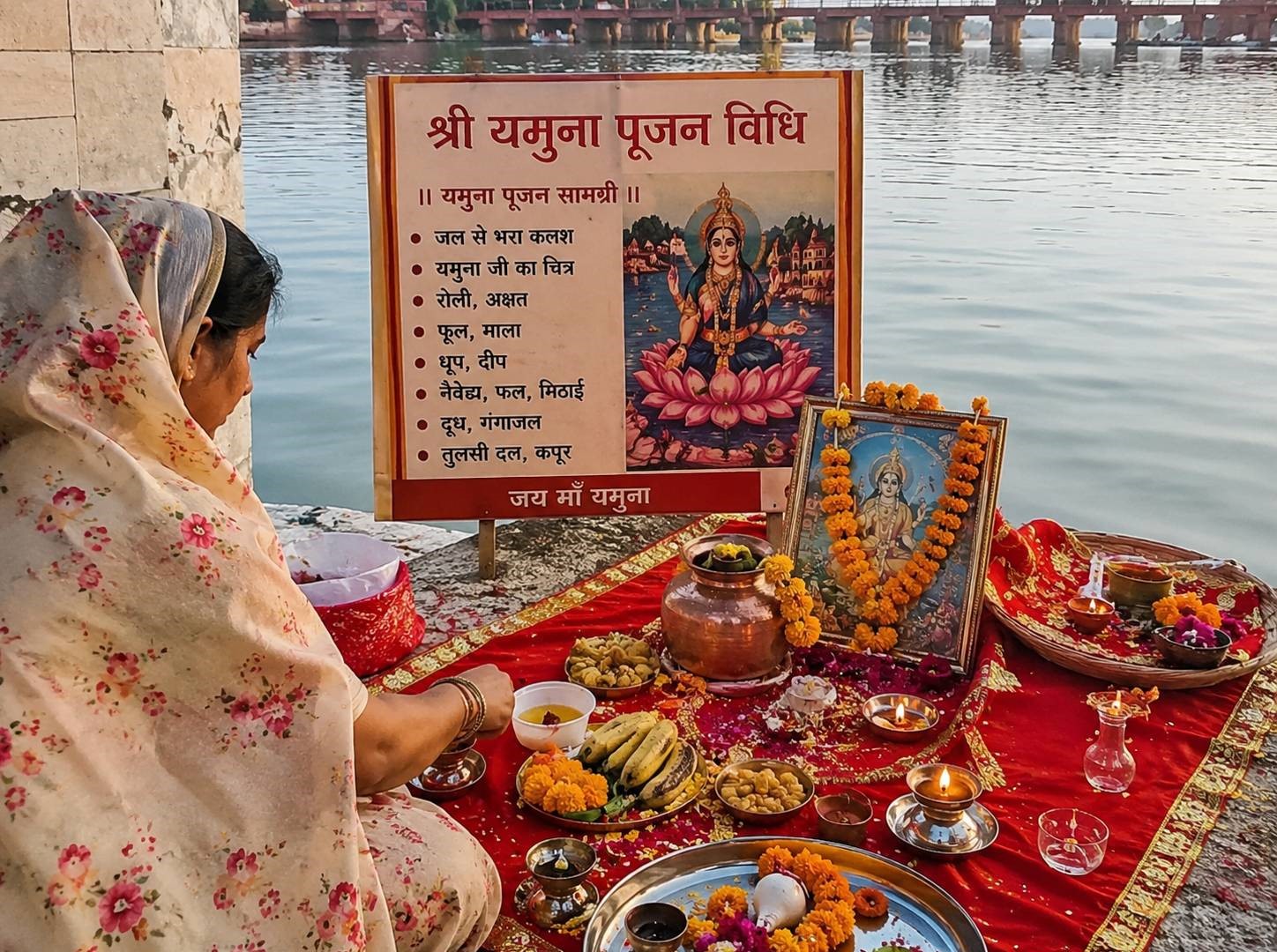
Bhai Dooj, also called Yama Dwitiya, is the Kartik Shukla Dwitiya observance centered on the bond between a sister and brother. The reviewed source connects it with the traditional remembrance of Yama and Yamuna and the sister’s prayer for her brother’s long life and well-being.
This guide follows the source’s complete home sequence: preparing the thali, remembering Yama and Yamuna, seating the brother, applying tilak, performing aarti, sharing food and distributing prasad.
Bhai Dooj Puja and Tilak Samagri
Tilak and puja thali
- A puja thali
- A diya, wick and ghee or oil
- Roli, kumkum and chandan
- Akshat, sindoor and kajal
- Flowers, a flower garland and durva
- Areca nut and betel leaves
- A coconut
- Mauli or kalava
- A clean handkerchief or cloth
- A kalash or lota with water
- Camphor
Food and family offerings
- Sweets, fruit and batashe
- A home-cooked meal for the brother
- A separate lamp for remembrance of Yama and Yamuna
Optional item named by the source
- A silver coin, if available
Before You Begin
- The sister and brother should bathe and wear clean clothes before the tilak ritual.
- Arrange the thali with the listed tilak materials, diya, sweets, mauli and water. Prepare the home-cooked meal before the ceremony where practical.
- Place a low seat or chowki in the worship area and cover it with the clean cloth. The source traditionally seats the brother facing east or north.
- Keep the lamp on a stable fire-safe surface. The source describes a separate evening lamp for Yama remembrance outside the home; follow local safety and household custom.
- Use the local panchang for the current year’s Dwitiya and tilak window instead of relying on a permanent clock time.
Complete Bhai Dooj Puja and Tilak – Step by Step
This is a family festival ritual rather than a generic deity shodashopachara puja. Follow the six source steps without adding unrelated kalash, abhishek or janeu procedures.
Prepare after bathing
After bathing and dressing cleanly, arrange roli or kumkum, chandan, akshat, flowers, diya, sweets, areca nut, coconut, mauli and the water lota in the thali. Begin with a brief remembrance of Lord Ganesha as stated in the source.
Remember Yama and Yamuna
Offer a brief prayer to Yama and Yamuna for the family’s long life and well-being. The source also describes lighting a four-faced lamp outside the home in Yama’s name during the evening; treat this as a customary additional observance and place any flame safely.
Yama and Yamuna salutationsOm yamaaya namah| Om yamunaayai namah|Meaning: Salutations to Yama; salutations to Goddess Yamuna.
Original Sanskrit
ॐ यमाय नमः। ॐ यमुनायै नमः।Seat the brother for the tilak
Seat the brother on the cloth-covered chowki, traditionally facing east or north, and place the clean cloth over his head. The source then places a paste of sindoor and ground rice on both hands, followed by five betel leaves, areca nut and the optional silver coin.
Apply the Bhai Dooj tilak
Using the ring finger of the right hand, apply roli or kumkum to the brother’s forehead and place akshat over it. Chandan and kajal may also be applied as the source describes. Recite either or both source prayers while making the blessing for long life and well-being.
Traditional Hindi tilak prayergamgaa pooje yamunaa ko, yamee pooje yamaraaja ko| subhadraa pooje shree krishna ko, gamgaa-yamunaa neera bahe, mere bhaaee kee aayu badhae|Meaning: The prayer remembers Ganga, Yamuna, Yami, Yama, Subhadra and Krishna while the sister prays for her brother’s long life.
Original Sanskrit
गंगा पूजे यमुना को, यमी पूजे यमराज को। सुभद्रा पूजे श्री कृष्ण को, गंगा-यमुना नीर बहे, मेरे भाई की आयु बढ़े।Sanskrit blessingyamaraajasya yamee jyeshthaa, tena dattam varam shubham| tasmaat tava bhavedaayuh, aarogyam sukhameva cha||Meaning: Through the auspicious blessing associated with Yami and Yama, may you receive long life, well-being and happiness.
Original Sanskrit
यमराजस्य यमी ज्येष्ठा, तेन दत्तं वरं शुभम्। तस्मात् तव भवेदायुः, आरोग्यं सुखमेव च॥Tie kalava and perform aarti
Tie mauli or kalava on the brother’s wrist and offer him a sweet. Light the prepared diya and perform aarti in the customary family manner while reciting the blessing below.
Aarti blessingaayushyam daaraarogyam cha, sukham cha paramam tathaa| praapnuyaat sarvasampattim, aayushmaan bhava sarvadaa||Meaning: May there be long life, well-being, happiness and every worthy form of abundance; may you always be blessed with longevity.
Original Sanskrit
आयुष्यं दारारोग्यं च, सुखं च परमं तथा। प्राप्नुयात् सर्वसम्पत्तिं, आयुष्मान् भव सर्वदा॥Exchange blessings, share the meal and distribute prasad
After the aarti, the brother receives his sister’s blessing and may offer her a gift according to his means. Serve the prepared home meal and share the sweets and fruit as prasad with the family. This meal and family exchange form the conclusion of the source ritual; no unrelated visarjan is required.
Simple Bhai Dooj Tilak Method at Home
The full source ritual is already suitable for the home. When time or materials are limited, this shorter form retains its central family actions without claiming to reproduce every regional custom.
- Bathe, wear clean clothes and prepare a thali with a diya, roli or kumkum, akshat, mauli and a sweet from the source list.
- Remember Ganesha, Yama and Yamuna with folded hands; recite “Om Yamaya Namah, Om Yamunayai Namah.”
- Seat the brother, apply tilak and akshat, and say the long-life prayer shown in Step 4.
- Tie mauli, perform a short aarti safely and offer the sweet.
- Exchange blessings, share a home meal if possible and distribute the offered sweet as prasad.
When Is Bhai Dooj Puja Performed?
Bhai Dooj is observed on Kartik Shukla Dwitiya, traditionally two days after Deepavali. The source places the tilak from morning toward midday and also recognizes the afternoon observance.
The exact Dwitiya span and suitable tilak period change each year and by location. Consult the current local panchang rather than using an exact muhurta written for another year.
Traditional Purpose of Bhai Dooj Puja
According to Hindu devotional tradition, Bhai Dooj expresses a sister’s blessing for her brother and renews affection and responsibility between siblings. Traditional longevity language is prayerful belief, not a guaranteed health outcome.
Blessing for the brother’s long life
The tilak prayers explicitly ask for ayush, a long and well-lived life, together with health and happiness.
Remembrance of Yama and Yamuna
The Yama Dwitiya tradition gives the family ritual its sacred context and connects the day with Yamuna’s hospitality toward her brother.
Strengthening the sibling bond
Tilak, blessing, food and the exchange of a gift give brother and sister a structured occasion to show care and gratitude.
Family gathering and shared food
The home-cooked meal and prasad bring the observance to completion through hospitality rather than through a long temple-style offering sequence.
Prayer for family well-being
The source includes prayer for longevity, health, happiness and abundance for the household in devotional terms.
Important Bhai Dooj Notes
- This ritual does not require a priest; it is traditionally performed within the family.
- If the optional silver coin or a decorative item is unavailable, omit it. Do not substitute unrelated puja materials.
- Keep the diya on a stable surface, especially during aarti and any customary evening lamp observance.
- Use clean vegetarian food prepared according to the family’s custom and distribute offered sweets or fruit as prasad.
- Regional forms differ. Preserve the family tradition where it changes nonessential details such as tray decoration or the precise tilak pattern.
Frequently Asked Questions
Yes. It is a family observance, and the complete six-step source sequence can be performed at home.
For the simplified source-based method, use a diya, roli or kumkum, akshat, mauli and a sweet. The full list supports the complete regional form.
Observe Kartik Shukla Dwitiya and use the current local panchang for the year’s daytime tilak period.
Yes. The source prayers are shown first in readable Roman letters, with the original text available directly below.
No. The Hindi source itself says “if available,” so it belongs to the optional group.
After tilak and aarti, exchange blessings, share the home-cooked meal and distribute prasad.