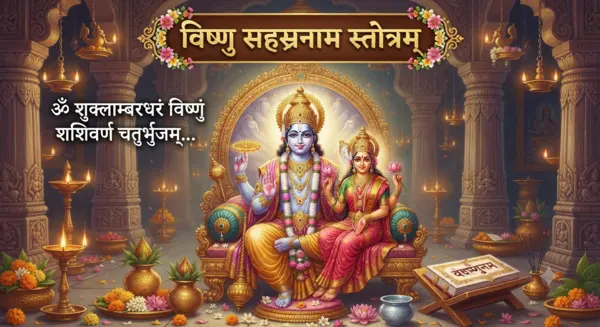
The Vishnu Chalisa praises Lord Vishnu as the sustainer of cosmic order and the dependable refuge of devotees. Its verses move between his serene divine form, his emblems, and remembered interventions through sacred avatars.
The complete Hindi source sequence appears below in readable Roman script, followed by natural English meaning and background that keeps the text devotional and accessible.
Quick Facts
Vishnu Chalisa Lyrics in English
Read the complete source-linked devotional sequence in simple Roman script.
Opening Doha
Vishnu sunie vinay, sevak ki chitalay
Kirat kuchh varnan karun, dijai jnyan batay
Vishnu Chalisa
Namo vishnu bhagavan kharari kasht nashavan akhil bihari
Prabal jagat men shakti tumhari tribhuvan phail rahi ujiyari
Sundar rup manohar surat saral svabhav mohani murat
Tan par pitambar ati sohat baijanti mala man mohat
Shankh chakr kar gada biraje dekhat daity asur dal bhaje
Saty dharm mad lobh na gaje kam krodh mad lobh na chhaje
Santabhakt sajjan manaranjan danuj asur dushtan dal ganjan
Sukh upajay kasht sab bhanjan dosh mitay karat jan sajjan
Pap kat bhav sindhu utaran kasht nashakar bhakt ubaran
Karat anek rup prabhu dharan keval ap bhakti ke karan
Dharani dhenu ban tumahin pukara tab tum rup ram ka dhara
Bhar utar asur dal mara ravan adik ko sanhara
Ap varah rup banaya hiranyaksh ko mar giraya
Dhar matsy tan sindhu banaya chaudah ratanan ko nikalaya
Amilakh asuran dvand machaya rup mohani ap dikhaya
Devan ko amrit pan karaya asuran ko chhavi se bahalaya
Kurm rup dhar sindhu majhaya mandrachal giri turat uthaya
Shankar ka tum phand chhudaya bhasmasur ko rup dikhaya
Vedan ko jab asur dubaya kar prabandh unhen dhundhavaya
Mohit banakar khalahi nachaya usahi kar se bhasm karaya
Asur jalandhar ati baladai shankar se un kinh ladai
Har par shiv sakal banai kinh sati se chhal khal jai
Sumiran kin tumhen shivarani batalai sab vipat kahani
Tab tum bane munishvar jnyani vrinda ki sab surati bhulani
Dekhat tin danuj shaitani vrinda ay tumhen lapatani
Ho sparsh dharm kshati mani hana asur ur shiv shaitani
Tumane dhruv prahalad ubare hiranakush adik khal mare
Ganika aur ajamil tare bahut bhakt bhav sindhu utare
Harahu sakal santap hamare kripa karahu hari sirajan hare
Dekhahun main nij darash tumhare din bandhu bhaktan hitakare
Chahat apaka sevak darshan karahu daya apani madhusudan
Janun nahin yogy jab pujan hoy yajny stuti anumodan
Shiladaya santosh sulakshan vidit nahin vratabodh vilakshan
Karahun apaka kis vidhi pujan kumati vilok hot dukh bhishan
Karahun pranam kaun vidhisumiran kaun bhanti main karahu samarpan
Sur muni karat sada sevakai harshit rahat param gati pai
Din dukhin par sada sahai nij jan jan lev apanai
Pap dosh santap nashao bhav-bandhan se mukt karao
Sut sampati de sukh upajao nij charanan ka das banao
Nigam sada ye vinay sunavai padhai sunai so jan sukh pavai
Closing Doha
Bhakt hriday men vas karen, purn kijiye kaj
Shankh chakr aur gada padm, he vishnu maharaj
Vishnu Chalisa Meaning in English
Opening Doha Meaning
The servant asks Vishnu to hear this humble request, attend to the heart, and grant the understanding needed to describe a little of his glory.
Chalisa Meaning
Salutations to Lord Vishnu, enemy of destructive forces and remover of suffering; his mighty power fills the world and spreads light through all three realms.
His form and countenance are beautiful, his nature gentle, and his presence enchanting; the yellow robe and Vaijayanti garland delight the mind.
The conch, discus, mace, and other emblems shine in his hands, making demons flee; before truth and dharma, lust, anger, pride, and greed cannot prevail.
He delights saints, devotees, and good people while breaking the strength of evil; he creates happiness, removes hardship, and corrects faults in those who seek goodness.
He cuts away sin, carries beings across the ocean of existence, and rescues devotees from sorrow; he takes many forms solely out of care for devotion.
When Earth appealed to him in the form of a cow, he took the form of Rama, lightened her burden, and destroyed Ravana and other oppressive beings.
As Varaha he brought down Hiranyaksha; as Matsya he entered the ocean and enabled its hidden treasures to be recovered.
When gods and demons struggled, he displayed the captivating Mohini form, gave nectar to the gods, and diverted the demons with that appearance.
As Kurma he supported Mount Mandara during the ocean churning; he also freed Shiva from danger by outwitting Bhasmasura through an enchanting form.
When demons submerged the Vedas, Vishnu arranged their recovery; he beguiled the wrongdoer into a dance that caused him to destroy himself.
The powerful demon Jalandhara fought Shiva and used deceit connected with Shiva’s appearance and the fidelity of his wife.
Parvati remembered Vishnu and told him the whole crisis; he then assumed a sage-like form and clouded Vrinda’s recognition.
Vrinda mistook him for her returning husband and embraced him; when the deception became clear, the force protecting the demon was broken and Shiva ended him.
Vishnu rescued Dhruva and Prahlada and destroyed Hiranyakashipu and other tyrants; he also carried Ganika, Ajamila, and many devotees across worldly existence.
The devotee asks the creator and compassionate Hari to remove every affliction and grant a vision of the friend of the poor and benefactor of devotees.
The servant longs for Madhusudana’s vision and mercy, admitting no knowledge of the proper worship, sacrifice, or words of praise.
He does not know the disciplines, vows, virtues, or subtle rules; uncertainty about how to worship causes deep sorrow.
He cannot decide how to bow, remember, or make an offering, while gods and sages serve continually and rejoice in the highest state.
Vishnu always supports the poor and suffering and accepts his people as his own; the prayer asks him to erase faults and release worldly bonds.
Grant children, resources, and happiness, and make the speaker a servant at your feet; the scriptures assure that one who reads or hears this prayer receives well-being.
Closing Doha Meaning
Lord Vishnu, bearing conch, discus, mace, and lotus, is asked to dwell in the devotee’s heart and bring every rightful task to completion.
Vishnu Chalisa: Background and the Work of Preservation
Vishnu is central to Vaishnava traditions and is remembered as the preserver of dharma. The Chalisa compresses visual praise, avatar memory, and personal petition into a form suitable for recurring devotion.
Preservation here is active, not passive. It includes restoring balance, defending the vulnerable, and sustaining conditions in which life and ethical order can continue.
Main Themes in the Vishnu Chalisa
Order and balance shape the hymn’s vision of divine power. Strength is used to sustain rather than dominate.
The avatar theme affirms responsiveness: sacred help is imagined as meeting the actual form of a crisis.
Refuge is personal and ethical. Trust in Vishnu is paired with a request to leave confusion and harmful behavior behind.
How to Read the Vishnu Chalisa
Thursday and Ekadashi are common devotional occasions. A reader may also use the Chalisa whenever there is a need to reflect on stability, responsibility, and refuge.
Pause at unfamiliar avatar names and consult the meaning rather than forcing speed. The Roman text supports sound while the background supplies context.
Frequently Asked Questions
It emphasizes Vishnu’s preserving role, divine form, compassionate interventions, protection of devotees, and restoration of order.
Avatar traditions show Vishnu responding to different kinds of disorder in forms suited to the need of the time.
They are traditional emblems of Vishnu and form part of the hymn’s imagery of sovereign, ordered, protective power.
Thursday, Ekadashi, and Vaishnava observances are common occasions, though personal reading is not limited to them.
No. The Chalisa is an extended devotional hymn; a mantra is a shorter sacred formula generally used in repetition.