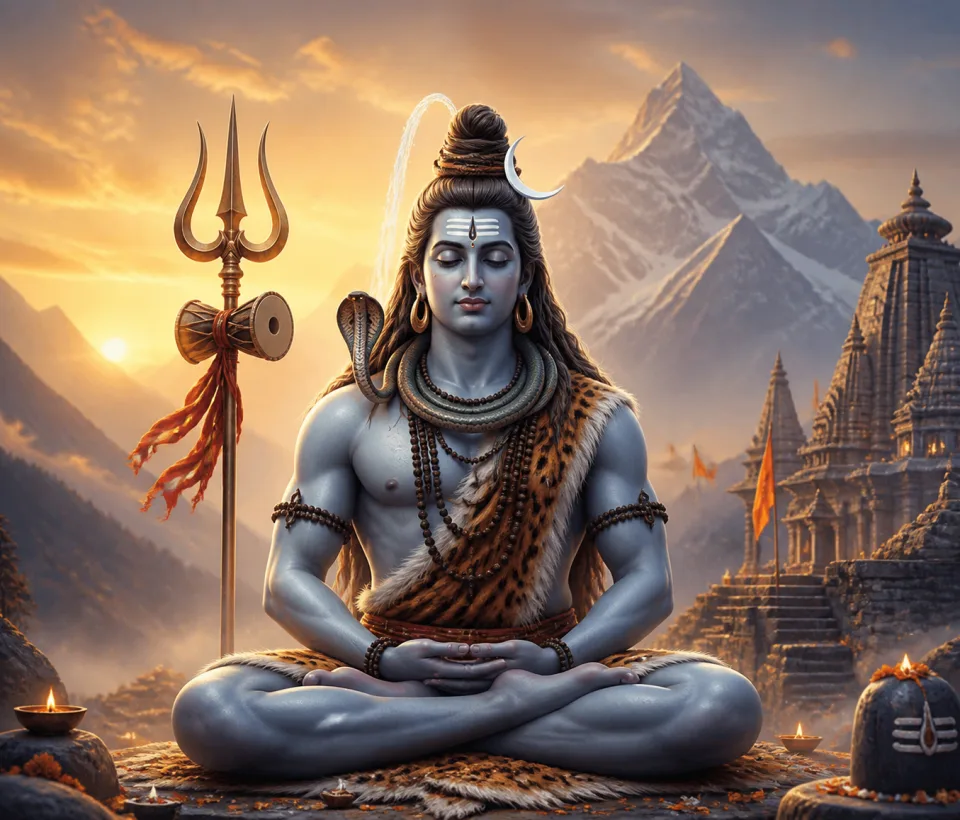
The Parvati Chalisa praises the daughter of the mountain as Gauri, Uma, Bhavani, and the beloved partner of Shiva. Its central narrative gives special attention to her unwavering austerity and freely chosen commitment.
All forty source stanzas from Hindi post 74 remain intact in Roman script, framed by the original opening and closing dohas and paired one-for-one with natural English meanings.
Quick Facts
Parvati Chalisa Lyrics in English
Read the complete source-linked devotional sequence in simple Roman script.
Opening Doha
Jay giri tanaye dakshaje, shambhu priye gunakhani
Ganapati janani parvati, ambe! shakti! bhavani
Parvati Chalisa
Brahma bhed na tumharo pave panch badan nit tumako dhyave
Shadmukh kahi na sakat yash tero sahasabadan shram karat ghanero
Teu par na pavat mata sthit raksha lay hit sajata
Adhar praval sadrish arunare ati kamaniy nayan kajarare
Lalit lalat vilepit keshar kunkum akshat shobha manahar
Kanak basan kanchuki sajae kati mekhala divy laharae
Kanth madar har ki shobha jahi dekhi sahajahi man lobha
Balarun anant chhabi dhari abhushan ki shobha pyari
Nana ratn jatit sinhasan tapar rajati hari chaturanan
Indradik parivar pujit jag mrig nag yaksh rav kujit
Gir kailas nivasini jay jay kotik prabha vikasin jay jay
Tribhuvan sakal kutumb tihari anu anu mahan tumhari ujiyari
Hain mahesh pranesh! tumhare tribhuvan ke jo nit rakhavare
Unaso pati tum prapt kinh jab sukrit puratan udit bhae tab
Budha bail savari jinaki mahima ka gave kou tinaki
Sada shmashan bihari shankar abhushan hain bhujang bhayankar
Kanth halahal ko chhabi chhayi nilakanth ki padavi payi
Dev magan ke hit as kinhon vish lai apu tinahi ami dinhon
Taki tum patni chhavi dharini durit vidarini mangal karini
Dekhi param saundary tiharo tribhuvan chakit banavan haro
Bhay bhita so mata ganga lajja may hai salil taranga
Saut saman shambhu pahaayi vishnu padabj chhodi so dhayi
Tehikon kamal badan murajhayo lakhi satvar shiv shish chadhayo
Nityanand kari baradayini abhay bhakt kar nit anapayini
Akhil pap trayatap nikandini maheshvari himalay nandini
Kashi puri sada man bhayi siddh pith tehi apu banayi
Bhagavati pratidin bhiksha datri kripa pramod saneh vidhatri
Ripukshay karini jay jay ambe vacha siddh kari avalambe
Gauri uma shankari kali annapurna jag pratipali
Sab jan ki ishvari bhagavati patiprana parameshvari sati
Tumane kathin tapasya kini narad son jab shiksha lini
Ann na nir na vayu ahara asthi matratan bhayau tumhara
Patr ghas ko khady na bhayau uma nam tab tumane payau
Tap biloki rishi sat padhare lage digavan digi na hare
Tab tav jay jay jay uchchareu saptarishi nij geh sidhareu
Sur vidhi vishnu pas tab ae var dene ke vachan sunae
Mange uma var pati tum tinason chahat jag tribhuvan nidhi jinason
Evamastu kahi te dou gae suphal manorath tumane lae
Kari vivah shiv son he bhama punah kahai har ki bama
Jo padhihai jan yah chalisa dhan jan sukh deihai tehi isa
Closing Doha
Kut chandrika subhag shir, jayati jayati sukh khani
Parvati nij bhakt hit, rahahu sada varadani
Parvati Chalisa Meaning in English
Opening Doha Meaning
The opening hails the daughter of the mountain and Daksha’s line, beloved of Shiva, mother of Ganesha, and divine power known as Amba and Bhavani.
Chalisa Meaning
Brahma cannot discover the limit of the Mother’s mystery, while five-faced Shiva continually meditates upon her.
Six-faced Kartikeya cannot fully tell her glory, and even thousand-headed Shesha exhausts himself trying.
None reaches her limit; she remains present for creation, preservation, and transformation.
Her coral-red lips and beautifully darkened eyes form the first intimate details of her appearance.
Saffron, kumkum, and sacred grains adorn her graceful forehead.
Golden garments and a fitted bodice are joined by a shining jeweled girdle at her waist.
A garland around her neck is so attractive that the mind is naturally drawn toward it.
She bears the endless radiance of the early sun, made beautiful by her ornaments.
She sits upon a throne set with many gems, attended in the hymn’s celestial vision by Vishnu and Brahma.
Indra and other divine families worship her amid the sounds of animals, serpents, yakshas, and the living world.
The hymn repeatedly praises her as the radiant resident of Mount Kailash.
All three worlds are her family, and her light is present within every smallest particle.
Mahesh is her beloved Lord and the continual protector of the three worlds.
The hymn says that the fruit of earlier merit ripened when she obtained Shiva as her husband.
Shiva’s old bull vehicle is mentioned with affectionate wonder at the unusual greatness of her Lord.
Shankar dwells in the cremation ground and wears fearsome serpents as ornaments.
The poison at his throat gives him the title Nilakantha.
He accepted poison for the welfare of the gods, giving them the nectar-like gift of safety.
Parvati is praised as the radiant wife of that Lord, destroyer of misfortune and bringer of auspiciousness.
Her supreme beauty astonishes even the maker and inhabitants of the three worlds.
The hymn poetically describes Ganga as timid before the Mother, her waves filled with modesty.
Ganga leaves Vishnu’s lotus feet and reaches Shiva in a relationship the poem compares with a co-wife.
Seeing the Mother’s lotus face fade, Shiva quickly places Ganga upon his head.
Parvati gives enduring joy and blessings and continually protects devotees from fear.
She destroys wrongdoing and the three afflictions and is Maheshwari, daughter of the Himalaya.
Kashi is dear to her, and the hymn recognizes it as a sacred seat of her power.
As Bhagavati she gives alms daily and ordains compassion, delight, and affection.
The prayer praises Amba as destroyer of hostile forces and asks her support for accomplished speech.
Gauri, Uma, Shankari, Kali, and Annapurna are named as forms of the Mother who sustains the world.
She is Goddess of all people, deeply devoted to her Lord, and praised as Sati and Parameshwari.
After receiving Narada’s instruction, Parvati undertakes severe austerity.
She gives up food, water, and even air until her body is reduced to little more than bone.
She refuses even leaves and grass, and the hymn connects this discipline with the name Uma.
The seven sages arrive to test and dissuade her, but her commitment does not waver.
Recognizing her steadfastness, the seven sages praise her and return to their homes.
The gods, Brahma, and Vishnu then arrive and offer to grant her a blessing.
Uma asks them for Shiva as her husband, the treasure sought by the three worlds.
They say “so be it,” and her heartfelt intention reaches fulfillment.
She marries Shiva and is again known as the beloved who shares Hari’s sacred household.
The central sequence closes with the traditional hope that readers receive family well-being and happiness.
Closing Doha Meaning
The closing praises the moon-like beauty upon Parvati’s head and asks the giver of happiness always to remain generous toward her devotees.
Parvati Chalisa: Background, Names, and Sacred Resolve
Parvati is remembered through names including Gauri, Uma, Bhavani, Shankari, Kali, Annapurna, and Maheshwari. The source treats these names as connected aspects of the mountain-born Mother.
Its longest narrative concerns her austerity after Narada’s instruction. She resists efforts to turn her away and chooses Shiva with unwavering intention, making resolve and agency central to the hymn.
Main Themes in the Parvati Chalisa
Steadfast devotion is the dominant theme: Parvati’s discipline continues despite discomfort and persuasion.
Divine partnership appears through Shiva and Parvati, whose contrasting forms hold household life, renunciation, protection, and grace together.
The Mother’s many names connect beauty and nourishment with the power to remove fear and wrongdoing.
How to Read the Parvati Chalisa
Monday, Gauri worship, and Hartalika Teej are familiar settings for Parvati devotion, though the hymn may be read at another respectful time.
Read the complete Roman stanza as one unit and use its paired meaning to follow the movement from visual praise to the story of austerity.
Frequently Asked Questions
The source includes Gauri, Uma, Bhavani, Shankari, Kali, Annapurna, Maheshwari, Sati, and other devotional names.
They describe Parvati’s severe austerity, the test by the seven sages, and the fulfillment of her wish to marry Shiva.
The hymn recalls his acceptance of poison for the welfare of the gods, which leaves his throat blue.
No. Its themes of resolve, devotion, protection, and grace are not restricted to one marital status.
One opening doha, forty central stanzas, and one closing doha are each preserved and explained.